
Most AI companies want you to use their product, their way, on their servers. Mistral AI is trying something different. This French company, founded in April 2023 by former researchers from Google DeepMind and Meta, is building frontier AI that you can actually own and control . They make open-weight models you can download and run yourself, plus a commercial platform for chat, coding, document intelligence, and custom model development.
Think of it like this: OpenAI and Google give you a really nice rental apartment. Mistral AI gives you the keys to the building. You can live there, renovate it, or move it to your own land. That difference matters a lot to certain people—especially businesses in finance, healthcare, and government.
In this article, I will explain what Mistral AI is, what you can do with it, how much it costs, and who should use it. I will keep it simple.
What Exactly Does Mistral AI?
The consumer entry point used to be called Le Chat. As of recent updates, it’s now called Vibe—Mistral’s AI assistant for everyday tasks and more complex work . The free plan is surprisingly generous. You get access to their best models, image generation, web search, file uploads, and over 100 connectors without pulling out a credit card . That’s not a trial. That’s a real usable product for free.
For developers, the API is designed to be easy to adopt. If you’ve built anything with OpenAI’s Chat Completions, switching to Mistral often just means changing the client, the base URL, and the model name. The pricing is generally cheaper, and in optimized deployments, you get sub-100ms latency.
But the real story is deployment flexibility. Mistral’s models run on their cloud (EU-hosted by default), your own private cloud, on-premises infrastructure, edge devices, or through partners like Azure, AWS, Google Cloud, IBM watsonx, and Snowflake . For a hospital in Germany or a bank in France, that choice isn’t a nice-to-have. It’s the whole ballgame. API data isn’t used for training, and Enterprise Vibe plans are opted out by default .
Document AI deserves its own mention. Mistral OCR handles PDFs, scans, invoices, tables, handwriting, charts, and multilingual documents—with on-prem deployment support for compliance-heavy sectors.
Why Do People Like Mistral AI?
1. It is very fast
When Mistral launched its updated chat app, it advertised responses of up to 1,000 words per second. In daily use, answers come quickly, which feels good when you are in a hurry.
2. Many models are open
This is a big difference from many other AI companies. Mistral shares some of its models for anyone to download. According to one recent guide, Mistral Large 3 and the whole Ministral 3 line ship under Apache 2.0. This means developers can download them, change them, and run them on their own computers.
3. Good for European users
Mistral hosts data in Europe by default and follows European privacy rules like GDPR. If you or your company care about where your data is stored, this is a real plus.
4. It speaks many languages
Mistral works well in French, Spanish, German, Italian, and other languages. It is a good choice for people who do not work only in English.
5. The price is lower than most rivals
We will look at this in detail below.
Where Mistral AI Falls Short
Let’s be honest. Mistral AI is not the best at everything. On the hardest reasoning benchmarks—the kind that test whether an AI can solve graduate-level science problems—Mistral’s models lag significantly behind Claude and Gemini. The description you provided notes GPQA Diamond scores around 44% against competitors exceeding 90%. Recent releases like Mistral Large 4 have improved things , but the gap on pure reasoning hasn’t fully closed.
The other big catch: Mistral is not turnkey. If you want to build a customer support tool or an internal knowledge base on top of their models, you’re looking at months of engineering work. The platform gives you a powerful engine. Integration, workflow, and user interface are your problem to solve. This isn’t a plug-and-play SaaS product. It’s infrastructure.
Mistral AI Pricing
Here’s how the plans stack up, based on Mistral’s official pricing page :
| Plan | Price | What You Get |
|---|---|---|
| Free | $0 | Access to latest models, limited messages and web searches, limited coding sessions, basic image generation, 100+ connectors |
| Pro | $14.99/month | Full Vibe access for all-day coding, more messages and searches, spreadsheet and slide generation, better image tools, $15/month in API credits, chat and email support |
| Team | $24.99/user/month | Everything in Pro, higher limits, faster responses, up to 30GB storage per user, domain verification, data export |
| Enterprise | Custom | Private deployments, custom models and agents, audit logs, SAML SSO, white-label options, dedicated support |
Verified students can get Pro for $5.99/month . API pricing is separate and charged per million tokens—for example, Mistral Large costs $0.50 per million input tokens and $1.50 per million output tokens, with batch processing cutting that by half .
Who Is Actually Using Mistral AI?
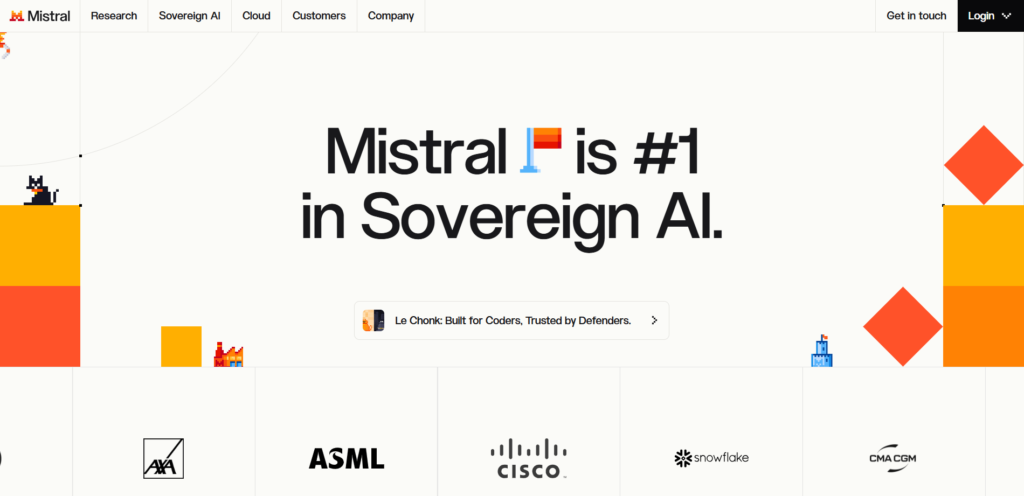
Enterprise customers include ASML, HSBC, Cisco, SAP, and Stellantis. BNP Paribas has spoken publicly about using Mistral to democratize AI access to 65,000 users while running entirely on their own infrastructure . That last part is the recurring theme. Banks don’t want their customer data floating through someone else’s servers in another country. Mistral solves that problem.
Pros and Cons, Simplified
The wins: Open-weight models you can download and customize. Deployment freedom across cloud, private cloud, on-prem, and edge. EU data sovereignty with API data excluded from training. A growing but still smaller ecosystem than OpenAI’s.
The friction: Reasoning gaps on the hardest benchmark tasks. Not turnkey—building real apps takes serious engineering effort. Fewer third-party integrations and tools than the bigger players.
The Final Thought
Mistral AI isn’t trying to win the chatbot popularity contest. It’s playing a different game. It’s betting that the future of enterprise AI isn’t about who has the snappiest interface, but about who gives companies the most control over their data, their models, and their deployment. For a hospital, a bank, or a government agency, that bet makes a lot of sense. For a random person who just wants a smart assistant on their phone, the free tier of Vibe is perfectly fine—but the real value is happening behind the scenes, in server rooms and compliance departments where “we own this” matters more than “this is cool.”
Alternatives to Mistral AI
ChatGPT by OpenAI
The biggest name in AI, offering GPT models through a polished API and ChatGPT interface. Far stronger on complex reasoning benchmarks, but you’re renting, not owning, and your data lives on their servers.
Anthropic Claude
Known for safety-focused AI and excellent reasoning capabilities, with Claude models accessible via API and consumer apps. Great for complex analysis and coding, but closed-weight and cloud-dependent.
Google Gemini
Deep integration with Google Cloud and Workspace, strong multimodal capabilities. A solid choice if you’re already in the Google ecosystem, but offers less deployment flexibility than Mistral.
Llama (Meta)
Meta’s open-weight model family is the closest direct alternative to Mistral’s open philosophy. You can download and self-host Llama models, though the licensing terms are more restrictive for large commercial users.