Health insurance is supposed to help people pay for medical care, but getting an insurance claim approved is not always easy. Sometimes, an insurance company refuses to cover a medicine, medical test, surgery, specialist visit, or other treatment. The reason may be unclear, and patients may not know what to do next.
This is where Counterforce Health can help. It is an AI-powered tool designed to help patients understand health insurance denials and prepare appeal letters. Instead of starting from a blank page, users can get a structured draft that explains why they disagree with the insurance company’s decision.
In this Counterforce Health review, we will explore its features, how it works, pricing, advantages, limitations, privacy concerns, and some alternatives worth considering.
What Is Counterforce Health?
Counterforce Health is an AI-powered health insurance appeal tool designed for the United States. It helps patients and healthcare teams respond when an insurance company denies a claim or refuses to approve a treatment.
The tool focuses on problems related to the American health insurance system. These may include denied prescription medicines, rejected prior authorization requests, medical procedures, imaging tests, and other healthcare services.
For example, imagine that your doctor recommends a particular medicine, but your insurance company refuses to cover it. The insurer may say that the medicine is not medically necessary or that you must try another treatment first.
Understanding this decision can be difficult. Counterforce Health helps users review the denial information, organize supporting evidence, and prepare a draft appeal letter explaining why the decision should be reconsidered.
The service is designed to make the appeal process easier for patients, caregivers, medical professionals, and patient advocacy teams.
Key Features of Counterforce Health
Counterforce Health focuses on making health insurance appeals easier to understand and prepare. Here are its main features.
1. AI-Powered Appeal Letter Generator
Writing an appeal letter can be difficult, especially when you are already dealing with a medical problem. You may not know which details to include or how to explain your disagreement professionally.
Counterforce Health uses AI to help prepare a first draft of an appeal letter based on the information you provide.
The draft can help explain the reason for the appeal, respond to the insurer’s stated concerns, and organize the supporting arguments.
You should carefully review the final letter and correct any mistakes before submitting it. Your doctor may also need to provide medical evidence to support your case.
2. Health Insurance Denial Analysis
Insurance companies often use technical terms and complicated policy language in their denial notices.
Counterforce Health can help users understand the information behind a denied claim and prepare a response based on the available documents.
For example, the denial may mention medical necessity, coverage exclusions, or a requirement to try another medicine before the requested treatment.
Understanding the specific reason for denial is an important first step. A useful appeal should address that reason rather than simply repeat that the treatment is needed.
3. Prior Authorization Support
Prior authorization is a process in which an insurance company requires approval before covering certain treatments, medicines, tests, or procedures.
A doctor may recommend treatment, but the insurer can still reject the request because of its coverage rules or documentation requirements.
Counterforce Health can help users organize the information needed to respond to a rejected prior authorization request and prepare an appeal.
This may be especially useful when a patient needs expensive medication, specialist care, or a procedure that requires additional approval.
4. Supporting Evidence Organization
An appeal is stronger when it includes relevant evidence that answers the insurance company’s concerns.
Depending on the case, useful documents may include:
- The insurance denial notice.
- Relevant health plan coverage documents.
- A letter from the treating doctor.
- Medical records supporting the requested treatment.
- Information about previous treatments and their results.
- Medical guidelines or research that support the doctor’s recommendation.
Counterforce Health can help users organize information for their appeal workflow. However, users must make sure that every document is relevant and that the appeal accurately reflects their medical situation.
5. Support for Different Types of Coverage Denials
Insurance denials can happen for many reasons. Counterforce Health is intended to help with appeal preparation for different types of healthcare coverage decisions.
Possible use cases include:
- Denied prescription medications.
- Rejected prior authorization requests.
- Procedures that an insurer considers unnecessary.
- Imaging tests and diagnostic services.
- Specialist care and other disputed healthcare services.
The available approach and appeal requirements depend on the insurance plan and the type of denial. Users should check whether their particular case is suitable for the service.
6. Useful for Patients, Caregivers, and Clinics
The tool is not limited to patients working alone.
A caregiver may use it to help a family member organize an appeal. Clinic staff may use AI-assisted drafting to reduce the time spent preparing routine paperwork. Patient advocates may also find it useful when helping people understand coverage disputes.
Healthcare professionals should still check the clinical details and make sure the final appeal reflects the patient’s actual medical history.
7. Free Access for Patients
One of the most attractive features of Counterforce Health is its free access for individuals.
According to the service’s published website and terms, it is currently offered free of charge. This makes it worth considering for patients who need help preparing an appeal but cannot afford a paid service.
The company states that its service is supported through grants and other funding rather than payments from insurance companies. Check its official website for the latest information about access and eligibility.
How Does Counterforce Health Work?
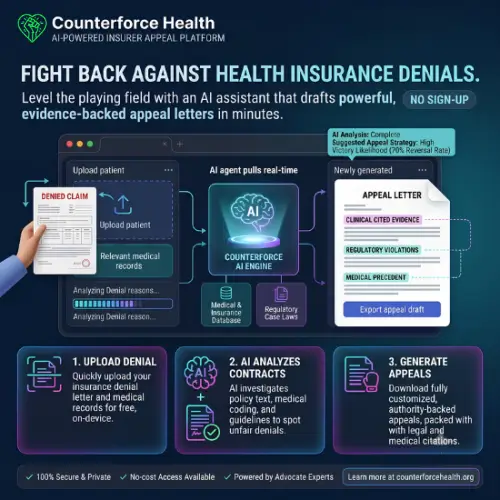
The general process is straightforward, although the exact steps may depend on the service’s current workflow.
Step 1: Collect your denial information
Start with the letter or notice explaining why your health insurance claim was denied. Identify the treatment, medicine, procedure, or service involved.
Step 2: Review the relevant documents
Gather the relevant insurance policy information and medical evidence. Your doctor’s notes or a letter explaining why the treatment is needed may be particularly important.
Step 3: Use the AI-assisted appeal workflow
Provide the relevant information through the service’s available workflow. Counterforce Health can help analyze the denial and prepare a draft response.
Step 4: Review the appeal letter
Read the draft carefully. Check names, dates, claim details, medical facts, policy references, and supporting arguments. Remove any statement that is inaccurate or unsupported.
Step 5: Ask your healthcare provider for help
When the denial involves medical necessity, your doctor may be able to explain why the recommended treatment is appropriate and provide supporting records.
Step 6: Submit the appeal yourself
Follow the instructions in your insurance company’s denial notice. Send the required documents through the specified online portal, fax number, or mailing address, and keep proof of submission.
Counterforce Health helps prepare the paperwork, but you remain responsible for checking and submitting the appeal.
Counterforce Health Pricing
Counterforce Health is currently advertised as a free service for patients and clinics. Its terms also state that the company may introduce fees for certain features in the future.
Here is a simple pricing overview based on the published information.
| Plan or service | Price | Best for |
|---|---|---|
| Patient access | Free | Individuals appealing insurance denials |
| AI appeal preparation | Free | Drafting and organizing appeal documents |
| Clinic access | Currently advertised as free | Healthcare teams supporting patients |
| Future paid features | Not specified | Depends on any future pricing changes |
Note: These are not separate subscription tiers. The table summarizes the currently published free-access model.
Is Counterforce Health Safe to Use?
Privacy is one of the most important things to consider when using any AI tool for health insurance paperwork.
Insurance documents may contain sensitive details, including medical histories, policy numbers, addresses, dates of birth, and patient identification information.
Counterforce Health’s published terms place responsibility on users to remove directly identifying personal information and protected health information before submitting documents. The terms also grant the company a broad license to use submitted content for providing, maintaining, developing, and improving its services and AI models.
This is an important consideration before uploading documents.
For better privacy, take the following precautions:
- Remove names, addresses, policy numbers, member IDs, and other direct identifiers before uploading documents.
- Avoid including information that is not necessary for preparing the appeal.
- Read the Counterforce Health privacy policy and terms of service.
- Confirm that you have permission before sharing another person’s medical information.
- Do not assume that an AI health tool offers the same privacy protections as your doctor or insurance company.
If you are uncomfortable with the published data-use terms, consider preparing your appeal offline using official government guidance instead.
Pros and Cons of Counterforce Health
Pros
- Free access: Patients can use the service without a current subscription fee.
- Saves preparation time: AI can help organize information and create a first draft.
- Simplifies complicated documents: It can help users understand technical insurance language.
- Supports appeal preparation: Users can organize arguments and relevant supporting evidence.
- Useful for caregivers and clinics: It can assist people helping patients navigate coverage disputes.
- Focused purpose: It is designed specifically around health insurance denials rather than general writing.
Cons
- Limited geographic focus: It is built around the United States health insurance system.
- Privacy considerations: Its terms require users to redact directly identifying information.
- AI errors are possible: Drafts may contain inaccurate, incomplete, or unsupported statements.
- No guaranteed approval: The insurer makes the final decision, not the AI tool.
- Manual submission is required: Users must follow the plan’s appeal process and send the documents themselves.
- Not a replacement for professional advice: Complex cases may require help from a doctor, patient advocate, insurance specialist, or attorney.
Who Should Use Counterforce Health?
Counterforce Health may be useful if you live in the United States and have received a health insurance denial that you want to challenge.
It can be particularly helpful for people who find insurance letters confusing or need a starting point for writing a formal appeal.
Patients dealing with rejected prescriptions, prior authorization problems, or disputes about medically necessary treatment may find the tool useful. Caregivers and clinic staff may also benefit from its document-preparation features.
However, it is not designed to resolve every insurance dispute. If your case involves a complex legal issue, a serious medical emergency, or an approaching deadline, seek appropriate professional assistance rather than relying on AI alone.
The service is also not a suitable substitute for India’s health insurance claims process because it is designed around American coverage rules.
Important Things to Know Before Appealing a Denial
Using an AI tool is only one part of the process. Before submitting an appeal, make sure you understand your rights and responsibilities.
In the United States, some insurance plans allow an internal appeal, in which the insurer reviews its decision again. Certain cases may also qualify for an independent external review. Eligibility, deadlines, and procedures depend on the plan and the type of denial.
The official HealthCare.gov appeal guide explains the general process.
Keep these points in mind:
- Read the denial notice carefully and identify the appeal deadline.
- Ask the insurer for the specific reason for denial if the explanation is unclear.
- Collect medical evidence that directly addresses that reason.
- Ask your doctor to support the appeal when clinical evidence is needed.
- Keep copies of the letter and every document you submit.
- Save proof that your appeal was sent and received.
- Ask about an expedited review if the situation meets the requirements for urgent handling.
Do not wait until the deadline is close to begin preparing your documents. An AI-generated letter does not extend an appeal deadline or guarantee that the insurer will change its decision.
Final Thoughts
Counterforce Health is a useful AI-assisted tool for people who need help challenging health insurance denials in the United States. Its main benefit is that it can turn complicated insurance information into a more organized starting point for an appeal letter.
The free access model is another advantage, especially for patients who are already dealing with medical expenses. Caregivers and clinic staff may also find it helpful when organizing documents and preparing appeal arguments.
However, users should approach it carefully. AI can make mistakes, medical evidence must be accurate, and the insurer’s appeal rules still apply. The published privacy terms also make it important to remove identifying information and understand how submitted content may be used.
Our verdict: Counterforce Health is worth considering if you need a free starting point for a US health insurance appeal. Use it to organize your case, verify the information, consult your healthcare provider when needed, and submit the appeal according to your plan’s instructions.
Alternatives to Counterforce Health
If you want to compare other tools, the following services and resources offer related help with health insurance denials, appeal letters, or the appeal process.
1. Health Appeal
Health Appeal is a free health insurance appeal tool that helps users understand denial notices, identify deadlines, and prepare appeal letters. It also provides guidance on supporting documents and possible next steps.
2. Remedy Support
Remedy Support offers free tools for understanding insurance denials, checking appeal deadlines, and preparing editable appeal letters. It also guides users through the process of submitting an appeal and finding further help.
3. HealthCare.gov
HealthCare.gov is an official US government resource that explains how to appeal health insurance decisions. It provides information about internal appeals, external reviews, required documents, and available assistance.
4. North Carolina Department of Insurance Medical Appeals Toolkit
This official state resource provides medical appeal guidance and sample letters for common denial reasons, including disputes over medical necessity. It is useful for people who prefer official instructions and want to prepare their appeal manually.
5. Centers for Medicare & Medicaid Services (CMS)
CMS provides official information about health insurance claim denials, consumer rights, and external reviews. It is a useful resource for understanding federal protections and finding the correct appeal route for eligible cases.
Which alternative should you choose? If you want another AI-assisted option, start with Health Appeal or Remedy Support. If you prefer official guidance and sample letters, HealthCare.gov and the relevant government insurance department are good starting points. Always check that a resource supports your specific insurance plan and type of denial.