
Let’s get one thing straight: buying an expensive SEO tool does not automatically bring visitors to your website. And publishing 100 AI-generated articles does not mean Google will send you traffic.
There are plenty of website owners spending $100–$300 every month on SEO software while their websites barely get visitors. Why? Because they confuse collecting SEO scores with actually doing SEO.
The tools below have made this list because they solve real content marketing problems. Some help with keyword research, some analyze competitors, and others help manage content production.
But none of them can replace experience, proper research, or a writer who understands what readers actually want.
A quick reality check: SEO is slow. You might spend three to six months publishing and improving articles before seeing meaningful organic traffic. In competitive niches, it can take longer. Your first affiliate commission, client payment, or advertising revenue could take months. There is no guaranteed payout date.
Let’s look at what these tools actually offer, where they help, and where you should save your money.
Quick Comparison: 10 AI SEO & Content Marketing Tools
| Tool | Best for |
|---|---|
| Frase | SEO research and content briefs |
| NeuronWriter | Affordable content optimization |
| Siteimprove.ai (MarketMuse) | Content strategy and topic planning |
| Clearscope | Improving content relevance |
| AirOps | Automated content workflows |
| Letterdrop | B2B content marketing |
| Keyword Insights | Keyword clustering and search intent |
| Content Harmony | Detailed SEO content briefs |
| Scalenut | AI writing and SEO optimization |
| BrandWell | AI-assisted content production |
So lets Explore Best AI SEO & Content Marketing Tools, One by One in detail:
1. Frase – Best for SEO Research and Content Briefs
Visit Frase Official Website >>
Best for: Bloggers, freelance writers, and small content teams.
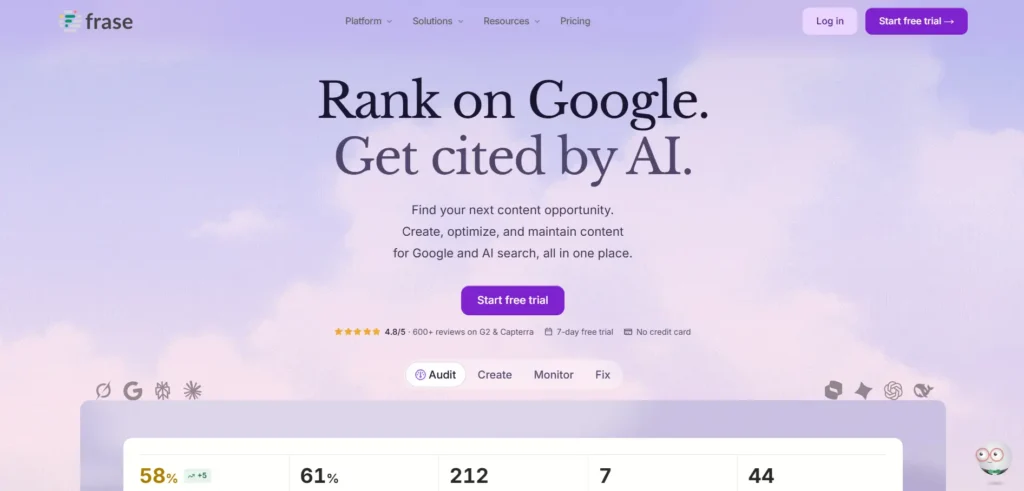
Frase is useful when you have a keyword but don’t know exactly what your article should cover. Instead of opening 15 competitor articles and manually checking their headings, you can use Frase to research the search results and prepare a content brief.
It helps identify common topics, questions, headings, and related terms that appear in competing content. You can then use that information to plan your own article.
It also offers AI writing and content optimization features, which can help speed up the process of moving from research to a first draft.
What I like: It brings research, outlining, writing, and optimization into one workflow. That’s useful when you’re publishing regularly.
The downside: Researching competitors doesn’t mean you understand the subject better than them. If you simply follow the same headings and produce another generic article, you haven’t added much value.
Who should skip this: If you publish only one or two articles every month, a dedicated subscription might not be worth the expense. You can do basic research manually before paying for another SEO tool.
My take: A sensible option for bloggers who spend too much time preparing articles before they actually start writing.
Visit Frase Official Website >>
2. NeuronWriter – Best for Affordable SEO Content Optimization
Visit NeuronWriter Official Website >>
Best for: Independent bloggers, niche website owners, and budget-conscious SEO writers.
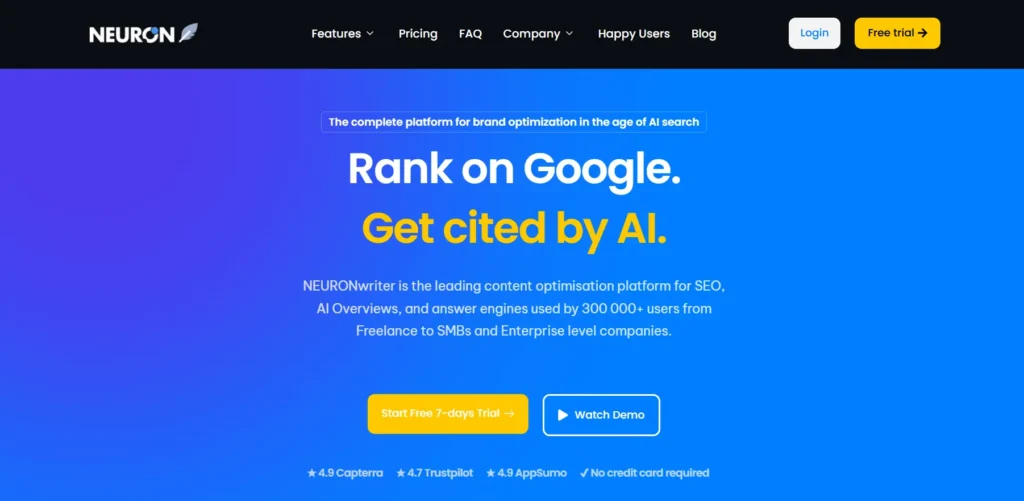
NeuronWriter is mainly focused on helping you improve existing or new content using competitor analysis and semantic SEO recommendations.
You enter a target keyword, and the platform analyzes competing pages to suggest related terms, topics, and other content elements worth considering.
It also provides content scoring and AI-assisted writing features.
Here’s where it becomes useful.
Suppose you have written an article about the best AI video generators. Your article covers five tools, but competing pages discuss additional features, pricing, use cases, and limitations.
NeuronWriter can help you identify some of those missing areas.
You still need to decide which suggestions make sense.
What I like: It offers several content optimization features without necessarily requiring an enterprise-level budget.
The downside: Don’t become obsessed with reaching a perfect content score. Adding irrelevant keywords just to increase a number can make an article worse.
Who should skip this: If you don’t understand basic SEO, keyword intent, or article structure, this software won’t magically teach you everything. Learn the fundamentals first.
My take: One of the first tools I’d investigate if I ran a small content website and wanted to improve articles without spending heavily.
Visit NeuronWriter Official Website >>
3. Siteimprove.ai (MarketMuse) – Best for Content Strategy and Topic Planning
Visit SiteImprove.ai Official Website >>
Best for: Established blogs, publishers, SEO agencies, and larger content teams.
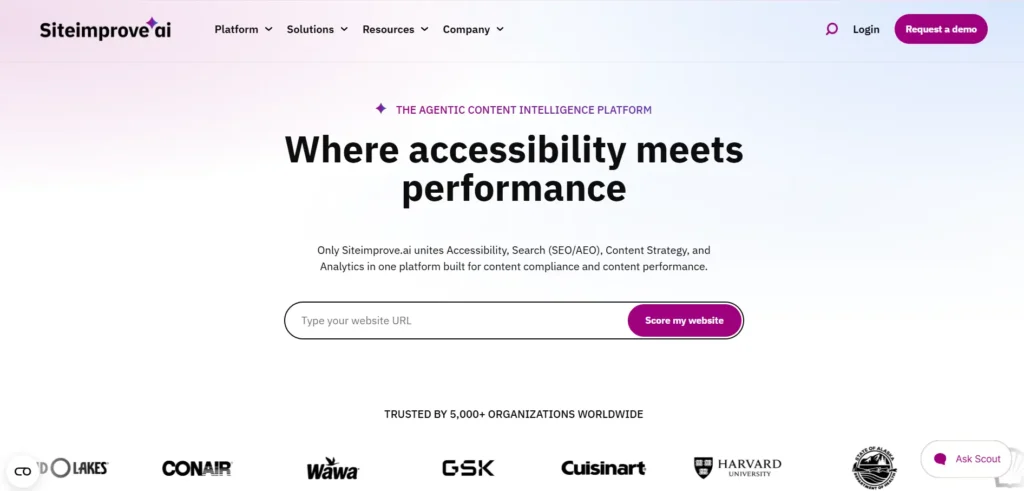
Siteimprove.ai (MarketMuse) takes a broader approach to SEO content planning.
Instead of looking at just one article, it helps you understand how well your website covers an entire subject.
For example, imagine you run a website about artificial intelligence. You have published articles about AI writing tools, AI image generators, AI video editors, and AI chatbots.
But you haven’t covered AI automation, AI agents, or AI productivity software.
MarketMuse can help identify topic coverage gaps and opportunities to develop a more complete content library.
This is particularly useful when you already have dozens or hundreds of published articles and need a better content strategy.
What I like: It focuses on the bigger picture rather than simply telling you which keywords to add to an individual article.
The downside: It may be excessive for a new website with ten published articles. You need enough existing content and a clear subject focus to get meaningful value from broader content planning.
Who should skip this: Beginners, hobby bloggers, and people running small websites with very limited publishing budgets.
My take: Better suited to serious content operations than someone starting their first blog.
Editorial correction: MarketMuse and Siteimprove are separate products and companies. They should not be presented as the same tool.
Visit SiteImprove.ai Official Website >>
4. Clearscope – Best for Improving Content Relevance
Visit Clearscope Official Website >>
Best for: Professional writers, editorial teams, and SEO agencies.
Clearscope is designed to help writers produce content that covers a topic properly.
It analyzes search results and provides recommendations about relevant terms and subjects that should be considered while writing.
Its content grading system makes it easier for editors to review articles and identify areas that might need improvement.
For example, if you’re writing about email marketing software, Clearscope might help you identify related topics such as automation, segmentation, deliverability, analytics, and email templates.
That doesn’t mean you should force every suggested term into the article.
Use your judgment.
What I like: The platform focuses on content quality and makes it easier for teams to maintain consistent editorial standards.
The downside: It is a premium product. Smaller website owners may find it difficult to justify the subscription, especially when cheaper alternatives can handle basic optimization.
Who should skip this: Beginners, individual bloggers with very limited budgets, and people who publish occasionally rather than regularly.
My take: A strong option for businesses that already have writers and editors. Probably unnecessary for a one-person blog.
Visit Clearscope Official Website >>
5. AirOps – Best for Automating Content Workflows
Visit AirOps Official Website >>
Best for: SEO agencies, publishers, and teams producing content at scale.
AirOps is different from a traditional content optimization tool.
It focuses heavily on AI-powered workflows.
You can build processes that connect different content tasks, such as researching information, generating drafts, updating existing pages, and preparing content for publishing.
For example, imagine you manage a website with 500 product pages.
Checking every page manually for outdated descriptions, missing information, and content improvements would take a considerable amount of time.
An automated workflow can help handle repetitive parts of that process.
AirOps is designed for teams that want to build these types of repeatable content operations.
What I like: The workflow approach. It is more interesting than simply asking an AI tool to write another article.
The downside: Automation requires planning. If your workflow uses poor instructions or unreliable source material, you can produce hundreds of poor-quality pages much faster.
That’s not progress.
Who should skip this: Solo bloggers who publish a few articles each month and people who aren’t comfortable setting up or managing automated workflows.
My take: Interesting for agencies and established publishers. Don’t buy it just because automation sounds impressive.
Visit AirOps Official Website >>
6. Letterdrop – Best for B2B Content Marketing
Visit Letterdrop Official Website >>
Best for: B2B companies, SaaS businesses, and marketing teams.
Letterdrop focuses on content marketing rather than just writing SEO articles.
B2B companies often need to create content for different stages of the buying process. They need blog posts, social media updates, product-related content, and material that helps potential customers understand what they offer.
Managing all these activities across different platforms can become messy.
Letterdrop aims to bring content planning, creation, management, and distribution into a more organized workflow.
It is particularly relevant for companies that want their content to support lead generation and sales.
For example, a SaaS company could use a single customer interview as the starting point for a blog post, social media content, and other marketing material.
What I like: It considers the entire content marketing process instead of focusing only on Google rankings.
The downside: Its B2B focus means that many individual bloggers and affiliate website owners won’t need most of its features.
Who should skip this: If you run a personal blog, an affiliate website, or a small niche website without a B2B marketing strategy, look elsewhere.
My take: Worth investigating if you manage content for a SaaS company. Not something I’d recommend to every blogger.
Visit Letterdrop Official Website >>
7. Keyword Insights – Best for Keyword Clustering and Search Intent
Visit Keyword Insight Official Website >>
Best for: SEO professionals, niche website owners, and content strategists.
Keyword research isn’t just about finding keywords with high search volume.
You also need to understand which keywords belong together and whether they deserve separate articles.
This is where Keyword Insights becomes useful.
It uses search engine results to group similar keywords into clusters based on ranking-page similarities. It also helps identify search intent and potential content opportunities.
Let’s say you collect these keywords:
- Best AI video generators
- AI video generator tools
- Top AI video creation software
- AI video makers for YouTube
Should you create four separate articles?
Probably not.
These searches may have similar intent, meaning one well-written article could target the group naturally.
Keyword Insights helps you investigate these relationships instead of guessing.
What I like: Its keyword clustering approach can save a lot of manual research when you’re planning a large website.
The downside: Keyword clustering isn’t a replacement for human judgment. Two keywords can look similar but still require different content depending on what searchers actually want.
Who should skip this: If you only target a handful of keywords and publish a few articles, a large keyword clustering platform might be unnecessary.
My take: Particularly useful for planning content on websites that cover hundreds of related topics.
Visit Keyword Insight Official Website >>
8. Content Harmony – Best for Creating Detailed SEO Content Briefs
Visit Content Harmony Official Website >>
Best for: SEO agencies, content managers, and businesses working with freelance writers.
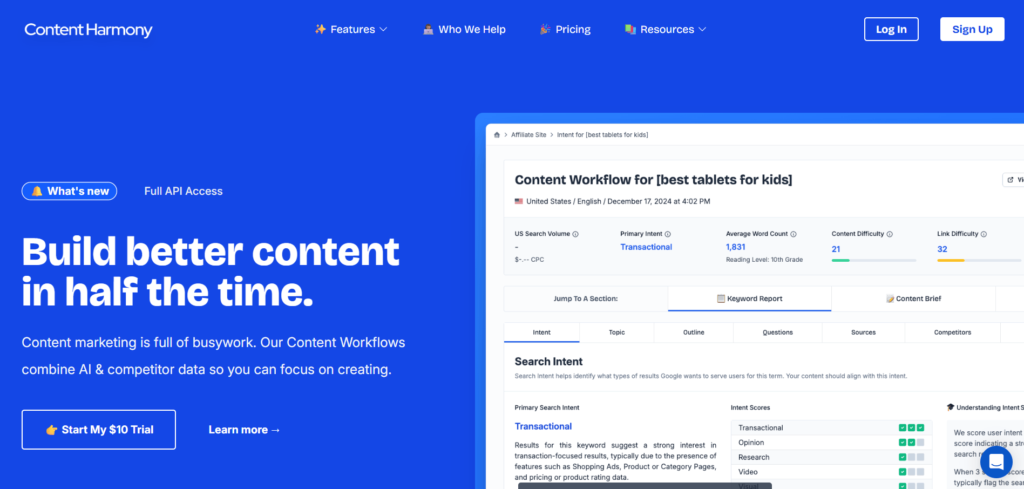
Content Harmony is built around content research and planning.
Its main purpose is to help teams prepare detailed content briefs before writers begin working on an article.
A proper content brief can include the article’s purpose, target audience, search intent, recommended headings, related keywords, questions to answer, and linking requirements.
Why does this matter?
Imagine you hire three freelance writers to create articles for your website. Without clear instructions, each person may follow a different writing style, structure, and level of detail.
You end up spending more time correcting their work.
Content Harmony helps organize the research and requirements before the writing begins.
It also offers content grading and workflow-related features.
What I like: It helps turn SEO research into clear instructions that writers can actually follow.
The downside: If you’re the only person researching and writing articles, some of its team-oriented features may not provide enough value.
Who should skip this: Solo bloggers who prefer doing their own research and don’t regularly outsource content production.
My take: A practical choice for agencies that need consistent briefs across multiple writers and projects.
Visit Content Harmony Official Website >>
9. Scalenut – Best for AI Writing and SEO Optimization

Visit Scalenut Official Website >>
Best for: Bloggers, content marketers, and small marketing teams.
Scalenut combines AI writing with SEO research and content optimization.
The idea is simple: you research a topic, plan the article, generate a draft, and optimize it using the platform’s recommendations.
Its content planning and optimization features are useful for people who want several parts of the writing process in one place.
For example, you could use Scalenut to prepare an article about the best AI presentation tools. It can assist with research, outlines, draft generation, and optimization.
But don’t confuse a finished AI draft with a finished article.
You still need to check product information, verify pricing, test tools where possible, and add your own observations.
What I like: Having research, writing, and optimization features together can reduce the number of separate tools you need.
The downside: AI-generated content can sound repetitive, particularly when you’re publishing articles in competitive niches. The tool cannot provide genuine product experience that you haven’t collected yourself.
Who should skip this: Writers who prefer complete manual control over their content and website owners who aren’t prepared to fact-check AI-generated information.
My take: Worth testing if you publish regularly and want to speed up the initial writing process. Just don’t turn your website into an AI article factory.
Visit Scalenut Official Website >>
10. BrandWell – Best for AI-Assisted Content Production

Visit BrandWell Official Website >>
Best for: Businesses, content marketers, and website owners producing SEO-focused content.
BrandWell is aimed at businesses that want to use AI to support their content production and marketing activities.
Its approach is broader than simply generating paragraphs from a keyword. The platform is associated with AI-assisted research, long-form content creation, and SEO-focused publishing workflows.
This can be useful when a business needs to maintain a regular publishing schedule without doing every repetitive task manually.
For example, a website covering software reviews might need to publish articles about new products, their features, pricing, and alternatives.
An AI content platform can help prepare an initial draft and organize the production process.
But there’s a catch.
Software reviews require accurate information. If you publish incorrect pricing or claim that a product has features it doesn’t offer, readers lose trust.
No AI tool fixes that problem automatically.
What I like: Its focus on combining content creation with marketing needs rather than treating writing as an isolated activity.
The downside: Before paying, check the current product features, publishing limits, and subscription details. Don’t assume every feature advertised in an older review is still available in the same form.
Who should skip this: People who don’t have a clear content strategy or those looking for a completely hands-off publishing solution.
My take: Worth exploring for businesses producing content regularly, but test its output before committing to a long subscription.
Visit BrandWell Official Website >>
Which AI SEO Tool Should You Actually Choose?
Here’s my honest recommendation. Don’t subscribe to all ten tools. Most of them overlap, and paying for multiple platforms doesn’t automatically improve your website.
Choose based on the problem you’re trying to solve.
| Your requirement | My pick |
|---|---|
| SEO research and article briefs | Frase |
| Affordable content optimization | NeuronWriter |
| Website-wide content strategy | MarketMuse |
| Professional editorial optimization | Clearscope |
| Automated content workflows | AirOps |
| B2B content marketing | Letterdrop |
| Keyword clustering | Keyword Insights |
| Detailed writer instructions | Content Harmony |
| AI writing and SEO | Scalenut |
| AI-assisted content production | BrandWell |
My Advice: Don’t Buy SEO Software Before You Need It
If you’re starting a new website, you don’t need five different subscriptions.
Start with the basics:
- Learn keyword research and search intent.
- Understand what your audience is searching for.
- Publish genuinely useful articles.
- Use Google Search Console to monitor organic performance.
- Improve articles that aren’t performing.
- Build relevant internal links between related pages.
Only pay for specialized software when you have a specific problem that it can solve.
Tools should save time, not create more expenses.
Can These AI SEO Tools Help You Make Money?
Yes, but not directly.
These platforms don’t pay you for using them. They’re business tools, not earning websites.
You can use them to support different business models:
- Affiliate marketing: Publish useful product comparisons and reviews with relevant affiliate links.
- Blogging: Build an audience through organic search and eventually monetize through advertising or sponsorships.
- Freelance SEO services: Offer keyword research, content briefs, and content optimization to clients.
- Content agencies: Manage research and writing workflows for businesses.
- Your own SaaS or business website: Attract potential customers through useful search-focused content.
But understand the timeline.
You might spend weeks researching, writing, editing, and publishing before getting meaningful results. Finding your first paying client can also take time.
And if you’re running an affiliate website, traffic alone doesn’t guarantee commissions. Visitors need to trust your recommendations and find the products useful.
No shortcuts. No guaranteed rankings. No magic button.
That’s the reality of SEO.
Editorial note: Features and subscription plans can change. Check the official product websites before purchasing. MarketMuse and Siteimprove are separate products; the third entry in this list refers to MarketMuse.