

Artificial intelligence is changing the way people search for information, build applications, and complete research. However, finding accurate and updated information is still a challenge for many AI tools. This is where You.com comes in. It combines real-time web search, AI-powered research, and developer-friendly APIs to help users get useful information faster.
You.com is more than a traditional search engine. It provides AI search infrastructure that developers and businesses can use to build intelligent applications, AI agents, research assistants, and other AI-powered products. Its platform connects large language models with real-time information from the internet, helping AI systems provide more relevant and up-to-date responses.
Whether you are a developer building an AI application, a business looking for better research solutions, or someone interested in AI-powered search, You.com offers several useful features worth exploring.
In this review, we will look at You.com’s features, pricing, benefits, limitations, use cases, and alternatives to help you decide whether it is the right platform for your needs.
What is You.com?
You.com is an AI search and research platform that helps people and businesses find information using artificial intelligence. It also provides APIs that developers can connect with their own applications, chatbots, and AI agents.
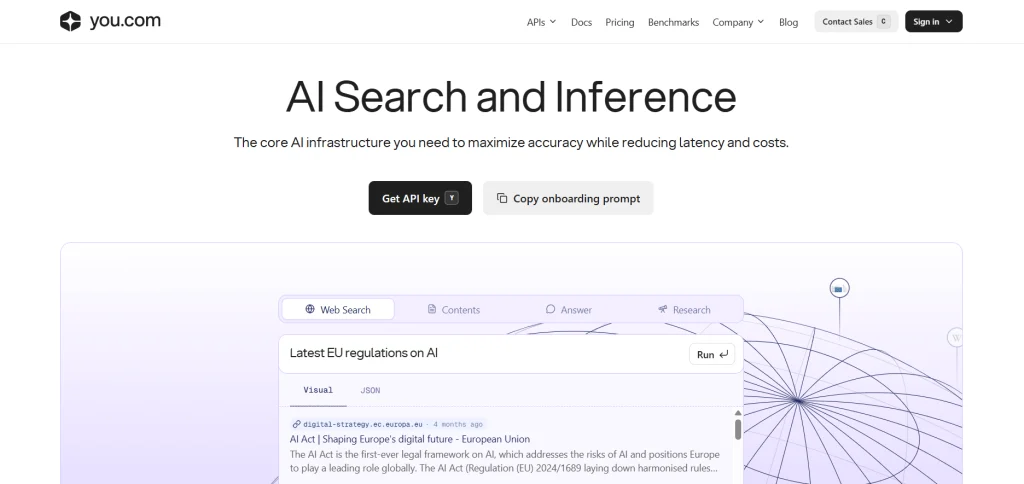
Unlike traditional search engines that mainly display website links, You.com can retrieve information, extract webpage content, and generate answers supported by sources. Its developer platform provides different APIs for web search, content extraction, research, and financial information.
The company was founded by Richard Socher and Bryan McCann. In September 2025, You.com announced a $100 million Series C funding round at a $1.5 billion valuation.
Its main goal is to make real-time internet information easier for AI systems to access and understand. This is especially useful for applications that need updated information instead of relying only on the data used to train an AI model.
You.com serves individual users, developers, startups, and large businesses that want to build more reliable AI-powered experiences.
Key Features of You.com
You.com offers several features for AI search, research, and application development. Let’s understand its most important features.
1. Real-Time Web Search API
The Web Search API is one of the main features of You.com. It allows developers to connect their AI applications with real-time information from the internet.
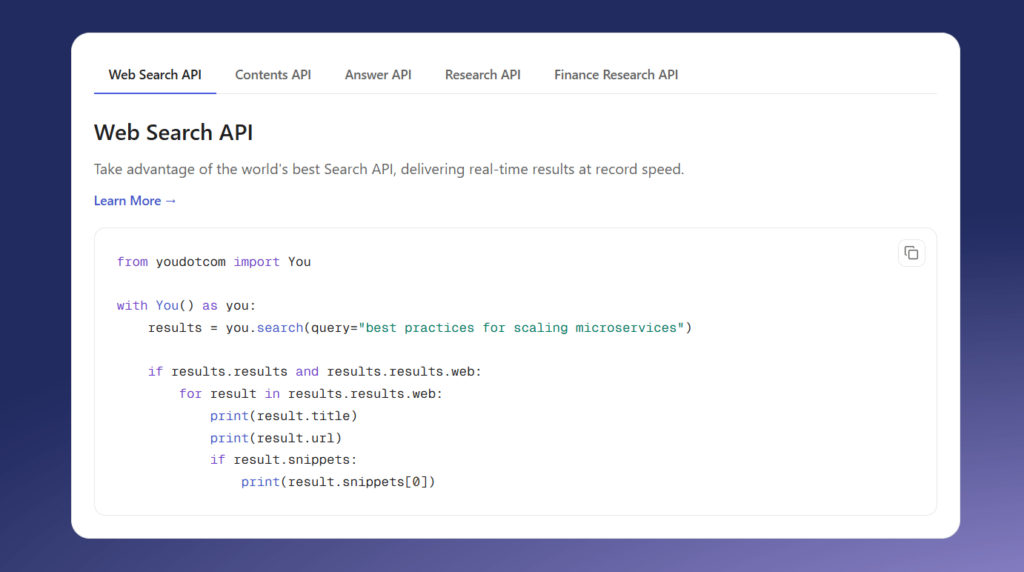
For example, imagine you are building an AI chatbot that answers questions about technology. A normal language model may not know about a product released yesterday. By connecting it with You.com’s Web Search API, your application can retrieve relevant online information and use it to prepare an updated answer.
The API returns structured search results that are easier for AI models to understand and process.
It is useful for:
- AI chatbots and assistants.
- Real-time information retrieval.
- Retrieval-Augmented Generation (RAG) systems.
- AI-powered search applications.
- Business research platforms.
2. ARI – Advanced Research & Insights
ARI stands for Advanced Research & Insights. It is You.com’s AI research agent designed to handle complex research tasks.
Instead of searching for information manually across multiple websites, users can give ARI a research topic and let it collect and analyze information from different sources.
It can process hundreds of sources and turn the findings into professional research reports with citations and visual elements.
For example, a business owner researching the electric vehicle market can use ARI to explore industry trends, competitors, customer demand, and market opportunities.
Some useful applications include:
- Market and competitor research.
- Business planning.
- Industry trend analysis.
- Investment research.
- Professional reports and presentations.
ARI was introduced in February 2025 and was later recognized in TIME’s Best Inventions of 2025 list.
3. News Search API
The News Search API helps applications retrieve updated news and information from online publishers.
This feature is useful for developers building applications that depend on current events. For example, a news monitoring platform can use it to collect information about business developments, technology announcements, and industry updates.
Rather than depending on old information stored in an AI model, applications can retrieve newer content from available online sources.
It can be useful for:
- News aggregation platforms.
- Market monitoring applications.
- Media research tools.
- Industry updates.
- AI-powered news assistants.
4. Contents API
The Contents API extracts information from specific webpages and converts it into clean formats such as Markdown or HTML.
Normally, webpages contain advertisements, navigation menus, formatting elements, and other unnecessary information. Extracting only the useful content can be difficult when building an AI application.
You.com’s Contents API helps solve this problem by collecting webpage content in a structured format.
For example, if you have a list of product review URLs, your application can use the API to extract their content and send it to an AI model for comparison.
This feature is useful for:
- Website content extraction.
- Document analysis.
- Research applications.
- AI knowledge bases.
- RAG applications.
5. Answer API
The Answer API is designed for applications that need a complete answer instead of a list of search results.
It performs a web search and uses the retrieved information to generate an answer supported by citations.
This saves developers from building their own complete search-and-answer workflow.
It can be useful when creating AI assistants, customer support applications, and research tools that need to provide answers with supporting sources.
6. Research API
The Research API is designed for questions that require more detailed investigation.
A normal search may return several useful pages, but complex questions often need information from multiple sources. The Research API can perform multiple research steps and generate a more detailed response.
It supports different research depths, allowing developers to choose an approach based on their requirements.
This is particularly useful for:
- Detailed market research.
- Business intelligence.
- Industry analysis.
- Technical research.
- AI research assistants.
7. Finance Research API
Financial information needs accuracy, context, and updated data. You.com’s Finance Research API is designed for applications that need information about companies, financial markets, business fundamentals, and related financial topics.
It uses a finance-focused index to support financial research.
Developers can use it to build financial research assistants, company analysis applications, and tools that help users understand market-related information.
Financial information should still be checked against official filings and trusted financial sources before making investment decisions.
8. AI Agent and Model Integration
You.com is designed to work with modern AI applications and language models.
Developers can connect its search capabilities with different AI models to build applications that can retrieve information and generate responses.
Its Inference Router API also provides access to supported open-weight AI models through a single interface.
This can reduce the work involved in managing different model integrations and search services.
9. Private Data and RAG Support
Another useful capability is the ability to build AI applications that work with private or company-specific information.
Retrieval-Augmented Generation, commonly called RAG, allows an AI application to retrieve relevant information from a selected knowledge source before generating an answer.
For example, a company can build an internal assistant that answers employee questions using its own documents and knowledge base.
This can help businesses create more useful AI assistants without depending entirely on general internet information.
For sensitive company data, businesses should review the platform’s security settings, data retention options, and contractual terms before deployment.
You.com Pricing Plans
You.com offers a free way to test its search capabilities, along with pay-as-you-go API pricing and custom enterprise solutions.
One important thing to understand is that its developer platform uses usage-based pricing. You generally pay according to the API calls or pages processed rather than purchasing a fixed monthly developer subscription.
Here is an overview of the publicly listed API pricing.
| API / Plan | Pricing | What You Get |
|---|---|---|
| Web Search API Free | Free | Up to 100 searches per day through MCP |
| Web Search API | $5 / 1,000 calls | Real-time web and news search results |
| Contents API | $1 / 1,000 pages | Extract webpage content into Markdown or HTML |
| Answer API | $5 / 1,000 calls | AI-generated answers with citations |
| Research API – Lite | $12 / 1,000 calls | Multi-step research with citations |
| Research API – Frontier | $1,200 / 1,000 calls | Advanced, in-depth research |
| Finance Research API – Deep | $110 / 1,000 calls | Detailed financial research |
| Finance Research API – Exhaustive | $500 / 1,000 calls | More comprehensive financial research |
| Inference Router API | Varies by model | Access to supported AI models |
| Enterprise Plan | Custom pricing | Enterprise security, higher limits, and dedicated support |
Prices are in USD. Research API pricing depends on the selected research depth. Additional usage, volume discounts, and enterprise arrangements may affect the final cost. Check the official pricing page before purchasing.
Is You.com free to use?
Yes. You.com offers a free Web Search API option through its MCP server, with up to 100 queries per day. This is useful for developers who want to test the service before spending money.
For production applications, you can switch to pay-as-you-go pricing. The platform also offers a $100 free credit promotion on its pricing page, subject to the applicable offer and account terms.
Who Should Use You.com?
You.com is mainly designed for people and businesses that need reliable search infrastructure or AI-powered research capabilities.
Here are some groups that can benefit from the platform.
1. Developers and Programmers
Developers can use You.com’s APIs to add real-time web search, webpage extraction, and research capabilities to their applications. It can save time when building AI-powered products.
2. AI Startups
Startups building AI assistants, chatbots, and research applications can use its APIs instead of creating their own search infrastructure from scratch.
3. Enterprise Businesses
Large organizations can use You.com to develop internal AI assistants, automate research tasks, and connect AI systems with external information.
4. Researchers and Analysts
ARI and the Research API can help users collect information from multiple sources and prepare detailed reports. This can be useful for market research, competitor analysis, and business planning.
5. Financial Technology Companies
Companies building financial applications can explore the Finance Research API for company information, financial news, and market research.
6. Small Agencies and Freelancers
Freelancers and small development agencies can experiment with the APIs to create custom solutions for their clients. The pay-as-you-go model can also make it easier to start with smaller projects.
Why Is You.com Different from Other AI Search Tools?
There are many AI search platforms available today, but You.com has a slightly different focus.
Its main strength is not simply answering questions for individual users. It also provides the infrastructure needed to build other AI-powered products.
For example, a developer building an AI research assistant may need three things:
- A search system to find updated information.
- A content extraction system to read webpages.
- An AI model to understand and summarize the information.
You.com provides APIs that can support these different tasks within one platform.
Another advantage is its modular approach. Developers can choose individual APIs depending on what they are building. They do not necessarily need to pay for a complete enterprise solution when they only need web search or content extraction.
This makes it an interesting option for developers who want more control over their AI applications.
You.com vs Perplexity vs Glean
You.com, Perplexity, and Glean all use AI to make information more accessible, but their main purposes are different.
| Feature | You.com | Perplexity | Glean |
|---|---|---|---|
| Main Focus | AI search infrastructure | AI-powered search and answers | Enterprise knowledge search |
| Real-Time Web Search | Yes | Yes | Available capabilities vary |
| Developer APIs | Yes | Yes | Enterprise integrations |
| Research Features | ARI and Research API | Deep Research | Enterprise knowledge discovery |
| Private Company Data | RAG and enterprise options | Depends on product and setup | Strong internal knowledge focus |
| Best For | AI developers and businesses | Individual research and answers | Workplace knowledge management |
You.com: A strong choice for developers who want to build AI applications using search and research APIs.
Perplexity: A useful option for people who want to ask questions, explore topics, and get answers with sources through an easy-to-use interface.
Glean: More focused on helping employees search and access information spread across company applications and internal systems.
The best choice depends on your requirements. If you want to build your own AI-powered search product, You.com is worth considering.
Pros and Cons of You.com
Before choosing any AI platform, it is important to understand both its advantages and limitations.
Pros
- Real-Time Information: Its search APIs help AI applications retrieve updated information from the internet.
- Multiple APIs: Developers can access search, content extraction, research, and financial research capabilities.
- Flexible Pricing: Pay-as-you-go pricing makes it possible to start without a large fixed platform commitment.
- Developer-Friendly: APIs, SDKs, and MCP integrations provide different ways to connect the platform with applications.
- Research Automation: ARI can collect and analyze information from hundreds of sources.
- Citation Support: Answer and Research APIs provide sources that help users verify generated information.
- Enterprise Features: Businesses can explore security, data retention, and dedicated infrastructure options.
- AI Model Integration: The Inference Router provides access to supported models through a common interface.
Cons
- Technical Knowledge Required: Some features require programming skills and API integration.
- Usage-Based Costs: Heavy API usage can increase costs, especially for complex research tasks.
- Not Just a Simple Chatbot: Users looking for a basic AI assistant may find the developer platform unnecessarily complex.
- Research Verification Is Important: AI-generated answers can still contain mistakes or incomplete information.
- Internet Dependency: Real-time search features depend on internet access and the availability of relevant sources.
- Learning Curve: Understanding APIs, authentication, usage limits, and integrations can take time for beginners.
Overall, You.com offers strong capabilities, but it is more suitable for people who understand what they want to build with AI.
How to Get Started with You.com
Getting started with You.com is relatively simple, especially if you are a developer.
Here is a basic process:
Step 1: Visit the Official Website
Open You.com and explore its available AI search and research products. If you want to build applications, visit its developer platform.
Step 2: Create an Account
Sign up for an account if required for the product or service you want to use. For the free Web Search MCP option, the official pricing page also lists access without an account or API key.
Step 3: Choose the Right API
Decide what your application needs. For example, choose Web Search API for live search results, Contents API for webpage extraction, or Research API for multi-step research.
Step 4: Generate Your API Key
For API access, visit the developer platform and generate an API key. Keep this key private and avoid exposing it in public code or frontend applications.
Step 5: Connect It to Your Application
Follow the official documentation to connect the API with your preferred programming language, AI model, or application.
Step 6: Test Your Results
Start with a few simple queries. Check whether the returned information is relevant, whether the citations work, and whether the response speed meets your requirements.
Step 7: Monitor Your Usage
Once your application is running, monitor API usage and spending. This will help you understand your actual costs before increasing traffic.
Is You.com Safe and Reliable?
You.com provides enterprise-focused security features, including SOC 2 certification, Data Processing Agreement readiness, and Zero Data Retention options.
These features can make it suitable for businesses that need more control over how their information is handled.
However, security requirements differ from one business to another. Before uploading confidential documents or connecting private databases, review the current privacy policy, data retention settings, and enterprise agreements.
It is also important to remember that AI-generated information should not automatically be treated as correct. Always verify important results, particularly when dealing with financial, legal, medical, or business decisions.
For developers, testing the platform with real-world queries before launching a production application is a sensible approach.
Final Thoughts
You.com is an interesting AI platform that goes beyond traditional search engines. Its combination of real-time web search, content extraction, research tools, and AI model integration makes it useful for developers and businesses building intelligent applications.
One of its biggest advantages is its modular API structure. Instead of building every search and information retrieval feature independently, developers can use different You.com APIs according to their project requirements.
ARI is another notable feature, especially for businesses and researchers who need detailed reports from multiple sources.
However, You.com is not necessarily the best choice for everyone. Beginners who simply want to chat with an AI assistant may prefer a simpler platform. Developers, startups, and enterprise teams looking to build AI-powered products will find more value in its infrastructure.
Our recommendation: If you are developing an AI chatbot, research assistant, RAG application, or real-time search product, You.com is worth testing. Start with its free search option and explore paid APIs only when your project needs them.
Alternatives to You.com
If You.com does not meet your requirements, there are several other AI search and research platforms worth exploring.
Perplexity provides AI-powered search with answers supported by website sources. It is useful for research, fact-finding, and exploring different topics.
2. Tavily
Tavily offers search APIs designed specifically for AI agents and LLM applications. Developers can use it to retrieve relevant web information for their AI workflows.
3. Exa
Exa provides AI-focused search infrastructure that helps developers retrieve relevant webpages and information. It is useful for semantic search, research applications, and AI agents.
4. Brave Search API
Brave Search API provides web search results that developers can integrate into their applications. It is a useful option for building search engines, chatbots, and AI assistants.
5. Firecrawl
Firecrawl helps developers crawl websites and convert webpage content into formats suitable for AI applications. It is particularly useful for building RAG systems and knowledge bases.
6. Glean
Glean focuses on enterprise search and workplace knowledge management. It helps employees find information across connected business applications and company data.
7. Algolia
Algolia provides search and discovery infrastructure for websites and applications. It is useful for businesses that need fast, customizable search experiences.