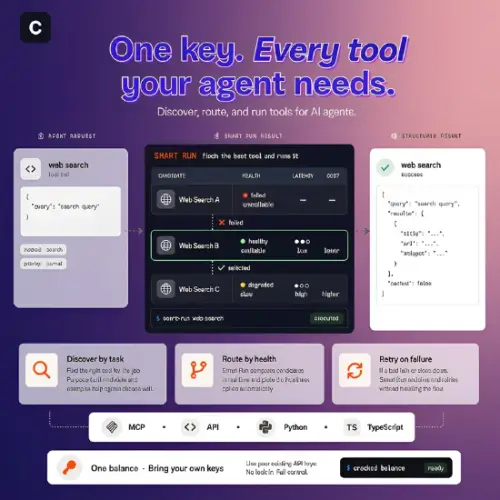
Cracked is an AI tool routing platform that helps developers connect AI agents to thousands of tools and APIs using a single account and API key. Instead of creating separate integrations for web scraping, data collection, social media research, and other tasks, users can discover and run supported tools through one platform.
What Is Cracked?
Cracked is a tool router built for AI agents and developers. It brings together different APIs, data services, scrapers, public MCP servers, and AI models in one place.
Normally, if you want an AI agent to search the web, collect company information, scrape a website, and generate an image, you may need to connect several different services. Each service can have its own API key, pricing system, and technical requirements.
Cracked aims to make this process easier. It provides access to a large catalogue of tools through a shared account and prepaid balance.
You can search for a tool using natural language, check its input requirements and pricing, and run it through the platform. Cracked can also select a suitable provider automatically when you use its Smart Run feature.
The platform covers different tasks, including web search, website scraping, SEO research, social media data, company information, maps, finance, messaging, file handling, and image or video generation.
According to its official website, Cracked connects AI agents to tens of thousands of tools and APIs. The exact catalogue size changes as tools and providers are added or removed.
How Does Cracked Work?
Cracked is designed to reduce the technical work involved in connecting AI agents to external services.
Here is how the process generally works.
1. Find the Right Tool
You can search the catalogue using a normal description of what you need. For example, you might search for a website scraper, an Instagram profile lookup tool, or a service that collects company information.
This makes it easier to discover tools without knowing every provider or API name.
2. Check the Tool Details
Before running a tool, you can inspect its input schema, price model, expected response time, and available documentation.
This step is useful because different tools may require different inputs or charge in different ways.
3. Run the Tool
You can call a specific endpoint directly or use Smart Run to request a capability rather than selecting a particular provider yourself.
For example, if you need to search the web or scrape a page, Smart Run can select a suitable available tool and prepare the request in the format that the provider expects.
4. Review the Result
Cracked returns the output along with details such as the selected provider, execution status, timing, and billing information.
This helps developers understand what happened during a request and how much it cost.
5. Use Automatic Fallbacks
When a supported tool fails, times out, or becomes unavailable, Smart Run may try another suitable candidate.
The platform considers factors such as provider availability, recent performance, latency, and price. However, fallback depends on the capability and available providers. It does not guarantee that every request will succeed.
Key Features of Cracked
1. One API Key for Multiple Tools
One of Cracked’s main advantages is that it reduces the need to manage separate credentials and billing balances for every supported service.
Instead of integrating each provider independently, developers can use Cracked as a shared access point.
This can simplify the development of AI agents that need information from multiple sources.
2. Natural Language Tool Discovery
Cracked lets you search for tools by describing the task you want to complete.
This can be helpful when you know what information you need but do not know which API provides it.
You can also inspect the available options before deciding which tool to use.
3. Smart Run Routing
Smart Run is one of the platform’s most useful features.
It allows an agent to request a capability without manually selecting a specific provider for every task. Cracked chooses an available candidate based on its routing information and the request requirements.
This can save development time, particularly when several providers offer similar services.
4. Automatic Fallback Support
An external API can become slow, unavailable, or return an error. Handling these situations manually can make an AI agent more complicated.
Cracked can retry a request using another eligible provider when supported conditions are met.
This improves flexibility, although developers should still test important workflows and prepare their own error-handling logic.
5. Pricing and Performance Information
Cracked provides information about endpoint prices, recent success rates, response times, and verification status where data is available.
These details help developers compare tools before using them.
Keep in mind that historical performance does not guarantee future results. New tools may also have limited performance data.
6. Cost Controls and Provider Selection
Users can apply cost limits and configure provider preferences or exclusions for supported routing workflows.
These options help control spending and avoid providers that do not suit a particular project.
They are especially useful for agents that make repeated API calls or operate without constant human supervision.
7. Multiple Integration Options
Cracked offers several ways to connect tools to AI applications, including:
- MCP connections for compatible AI clients
- HTTP API access
- Command-line tools
- Python and TypeScript SDKs
- Integrations for frameworks such as LangChain, CrewAI, Vercel AI SDK, and OpenAI Agents
The exact setup depends on your development environment and the integration you choose.
8. Asynchronous Tasks and Webhooks
Some tasks take longer to complete than a normal API request.
Cracked supports asynchronous runs for supported workflows. These can return a run ID that you can use to check progress or receive results through webhooks.
The platform also documents features for batches, schedules, datasets, monitors, and alerts.
These capabilities can help developers build more advanced automated workflows.
9. Bring Your Own Provider Keys
For selected services, you can connect your own provider API keys instead of using Cracked’s supported provider accounts.
This option may be useful if you already have an account with a particular provider or want more direct control over your provider relationship.
Provider charges and terms still apply when you use your own keys.
10. Agent Onboarding
Cracked supports agent self-registration, allowing an agent to create a workspace and receive trial credit through supported onboarding methods.
This can make testing and development easier because the human owner does not always need to complete every initial setup step manually.
However, spending limits should be configured before an agent starts making paid requests automatically.
Cracked Pricing
Cracked uses a freemium, pay-per-use pricing model rather than requiring every user to purchase a fixed monthly subscription.
The platform’s official documentation states that new workspaces receive starting credit. Usage costs depend on the selected provider, its pricing model, and Cracked’s platform fee.
Here is a summary of the published pricing structure.
| Pricing item | Cost |
|---|---|
| Starting workspace credit | $2 for a new workspace |
| Tool discovery | Free |
| Tool inspection | Free |
| Platform fee | $0.001 per successful run |
| Provider usage | Depends on the selected tool |
| Provider markup on Cracked’s accounts | Upstream rate plus 15% |
| Using your own provider key | Provider portion is not charged by Cracked; platform fee applies |
| Failed upstream calls | Not charged under the documented failure rules |
| Credit validity | Purchased credit is generally valid for 12 months |
Important: The table describes Cracked’s published billing model, not a fixed price for every API call. Some tools charge per call, while others charge based on results, units, tokens, or usage time. Review the live price before running a tool.
For example, if a successful request has a provider cost of $0.02, and the applicable platform fee is $0.001, the total would be $0.021 before any applicable taxes.
The cost can be higher for expensive services or repeated calls. Cached requests may cost less when caching is supported.
You should check the official documentation before adding a large prepaid balance because billing rules, provider prices, and credit conditions can change.
Pros and Cons of Cracked
Pros
- One access point: Connect to many external tools without managing every integration separately.
- Flexible tool discovery: Search for services using natural language.
- Smart routing: Automatically select suitable providers for supported tasks.
- Fallback support: Retry eligible requests through alternative providers.
- Transparent usage records: Review execution status, timing, and billing information.
- Multiple integrations: Use APIs, MCP, SDKs, and command-line tools.
- Pay-per-use model: Suitable for projects that do not need a fixed monthly tool subscription.
- Cost controls: Set limits and configure provider preferences for supported workflows.
Cons
- Costs can vary: The total price depends on the provider and the type of request.
- Technical knowledge is useful: Developers may need to understand APIs, authentication, and input schemas.
- Not every tool is always available: Some providers require your own key or may be unavailable.
- Limited independent feedback: As a relatively new platform, Cracked has less established user feedback than many mature developer services.
- Data handling needs attention: Run inputs and outputs are stored alongside execution and billing records.
- Performance is not guaranteed: Routing and historical success rates cannot ensure that every request will return accurate data.
Cracked states that it does not currently hold a SOC 2 report. If you plan to process confidential business information, private customer records, or sensitive data, review its privacy policy, retention rules, and provider terms before using the service.
Who Should Use Cracked?
Cracked is primarily designed for people who build AI agents and automated applications.
AI agent developers: If your agent needs information from several external services, Cracked can simplify the integration process.
Automation builders: Developers creating workflows for research, data collection, or content operations may find the shared tool catalogue useful.
SaaS founders: Teams building AI-powered products can explore multiple data providers without implementing every connection from scratch.
Technical teams: Developers who already work with APIs, Python, TypeScript, or MCP can use its integration options to build more flexible applications.
AI enthusiasts: People experimenting with AI agents may find the platform useful for learning how agents interact with external tools.
However, Cracked may not be the best choice for someone who simply wants a ready-made chatbot or an easy drag-and-drop application with no technical setup.
Is Cracked Safe to Use?
Cracked can be useful for development, but its suitability depends on what you plan to send through the platform.
According to its published information, it encrypts connected provider credentials at rest and stores API keys as hashes. It also records the inputs and outputs of tool runs.
These details matter because your requests may contain information that you do not want stored or shared with external providers.
Before using Cracked for business-critical work, consider the following precautions:
- Avoid sending passwords, private customer information, or confidential documents unless you have confirmed the relevant data-handling terms.
- Review the privacy policy and data retention rules.
- Start with a small prepaid balance.
- Set spending limits before enabling unattended agents.
- Test the tools you intend to use and verify their output.
- Keep an alternative integration for important workflows where predictable availability is essential.
No platform can guarantee complete security or perfect results. Review the current terms and documentation before relying on Cracked for sensitive work.
Final Thought
Cracked is an interesting option for developers who want to connect AI agents to multiple external tools through a shared platform. Its combination of natural language discovery, Smart Run routing, automatic fallback, performance information, and pay-per-use billing can reduce some of the work involved in building AI-powered applications.
Its biggest advantage is convenience. Instead of creating and maintaining every integration separately, developers can discover and run many supported services from one place.
However, Cracked is not a replacement for every automation platform or API provider. Its costs can vary, some integrations require additional setup, and users need to understand its data-handling policies.
If you are building an AI agent, start with the free discovery and inspection features, test a few tools, and monitor the actual cost and output quality. If the platform meets your requirements, it may be a useful part of your development setup.
Alternatives to Cracked
1. Agentik
Agentik helps AI assistants connect with a wide range of external tools through an MCP connection. It is worth considering if you want a shared interface for research, SEO, data enrichment, and media-related tasks.
2. Monid
Monid focuses on natural-language tool discovery, endpoint pricing, and shared prepaid access through MCP, a command-line interface, and an API. It may suit developers looking for a similar way to discover and run external tools.
3. n8n
n8n is a workflow automation platform for connecting applications, APIs, and AI agents. Its visual editor, branching logic, custom code support, and self-hosting options make it useful for building complete automated workflows.