Most ecommerce sellers don’t have a shortage of AI tools. They have a shortage of time, money, and patience for managing ten different subscriptions.
One tool finds products. Another checks competitors. A third creates product images. Then you need something else to make TikTok videos and another tool to track keywords.
Nexscope is trying to put all these jobs under one roof.
And honestly, that’s an interesting idea. Instead of jumping between research platforms and AI video generators, you can use Nexscope to research products, study competitors, create marketing assets, and even connect the platform to an AI assistant.
But having lots of features doesn’t automatically make a product worth buying.
The real question is whether Nexscope can save enough time and money to justify another monthly subscription.
Let’s look at what it offers, where it makes sense, and what you should check before paying.
What Is Nexscope?
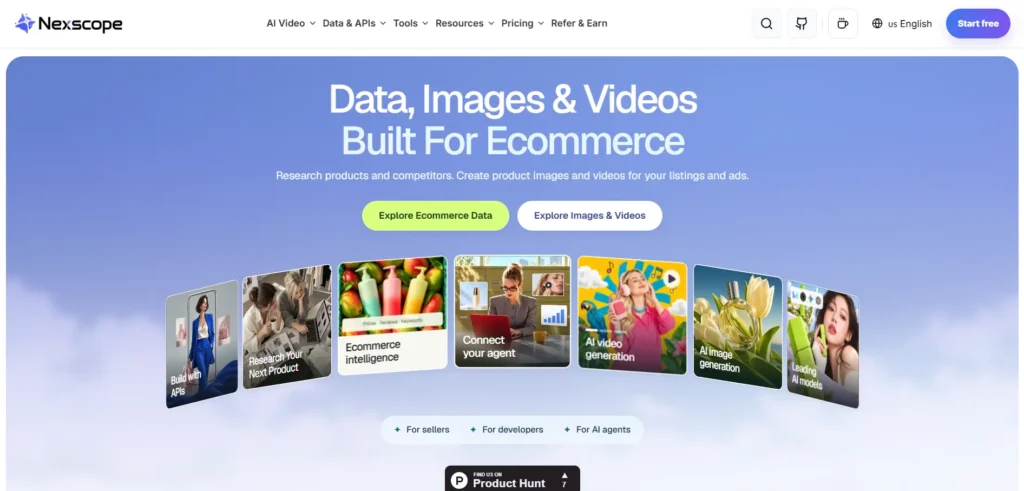
Nexscope is an ecommerce research and AI content creation platform designed for online sellers, agencies, and developers.
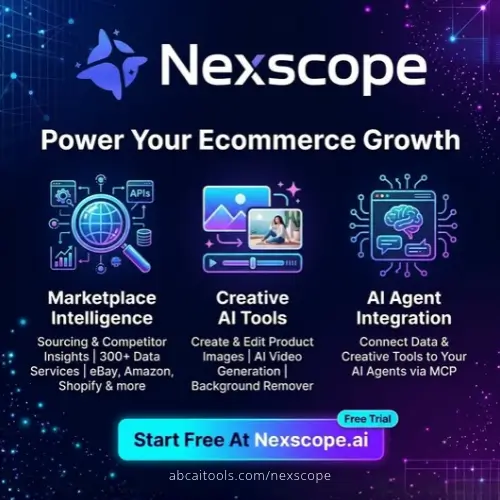
It combines marketplace data, product research, competitor tracking, keyword analysis, AI product photography, video generation, and API access. You can use it directly or connect it to an AI assistant through its API and MCP support.
The idea is simple: research a product and create the marketing content for it without constantly switching between different platforms.
What Does Nexscope Actually Do?
Nexscope has two main jobs.
The first is helping you understand the market before you invest money in a product. It provides information about products, competitors, keywords, reviews, pricing, and marketplace activity.
The second is helping you create content to sell those products. You can generate product images, lifestyle photographs, promotional videos, and UGC-style advertisements.
For example, imagine you want to sell a skincare product on Amazon and TikTok Shop.
You could use Nexscope to:
- Research similar skincare products.
- Check competitor listings and product prices.
- Find keywords that people are searching for.
- Study product reviews and identify common customer complaints.
- Create product listing images.
- Generate a short promotional video.
- Prepare different creative versions for advertising.
That’s a fairly useful workflow.
Instead of paying separately for several research and creative tools, you get access to both categories through one platform.
However, don’t confuse having everything in one dashboard with getting perfect results. You still need to check the information and review the AI-generated content before using it.
Marketplace Research: One of Its Biggest Strengths
Product research is where Nexscope starts becoming interesting.
Choosing a product based on a viral TikTok video or a competitor’s success is a risky way to run an ecommerce business. A product might look popular, but that doesn’t mean there’s enough demand, healthy profit margins, or room for another seller.
Nexscope provides access to more than 300 data services from multiple providers.
It supports marketplace research across platforms such as:
- Amazon
- TikTok Shop
- Shopee
- Walmart
- Etsy
- eBay
- Temu
- Shopify
- 1688
- Ozon
- Mercado Libre
- Google data for keyword research
This is particularly useful for sellers working across different countries.
For example, someone sourcing products through 1688 and selling them through Shopify or Amazon can use marketplace information to study opportunities before placing a large order.
You can also research ASINs, product details, competitors, pricing, and reviews.
But here’s something worth remembering.
Marketplace data is useful only when it’s accurate, relevant, and recent enough for your decision. Don’t blindly trust a sales estimate or product ranking and invest thousands of dollars based on one number.
Use the data to narrow down your options. Then verify the demand, shipping costs, competition, fees, and actual profit margins.
Keyword Lab for Product and Competitor Research
Keyword research is another important part of Nexscope.
Its Keyword Lab can start with a keyword or ASIN and help you investigate what competitors are ranking for.
It focuses on areas such as:
- Competitor keyword analysis.
- Long-tail keyword opportunities.
- Listing keyword gaps.
- Keyword rank tracking.
- Product visibility and ranking information.
Let’s say you’re selling wireless earbuds on Amazon.
You already have a product listing, but you’re not getting enough organic traffic.
Instead of randomly changing the product title and description, you can research competitor keywords and look for relevant search terms that your listing might be missing.
Long-tail keywords can also help you find more specific searches.
For example, there’s a difference between targeting “wireless earbuds” and a more specific phrase describing noise cancellation, battery life, or a particular use case.
Nexscope also includes product rankings tracking and a listing checker.
These tools can help you monitor performance and identify areas where your listing needs improvement.
There’s also a GEO Score Checker that looks at how products appear in AI search.
This is an interesting addition because product discovery is no longer limited to traditional search engines and marketplace search bars.
Still, don’t expect a keyword tool to automatically improve your sales. It can help you make better listing decisions, but product quality, pricing, reviews, and customer demand still matter.
Buy Box Repricer: Useful, But Don’t Hand Over Control
Pricing products manually can become frustrating when you’re competing with several sellers.
You might be selling the same product as five other businesses. One competitor reduces the price, another changes their inventory, and suddenly your listing becomes less competitive.
Nexscope offers a Buy Box Repricer to help with this problem. It checks factors such as:
- Current product pricing.
- Inventory information.
- Buy Box status.
- Your minimum profit margin.
Based on this information, it suggests price adjustments.
The good part is that you approve the proposed changes before they go live.
I prefer this approach over blindly allowing an automated system to change prices without supervision.
Why?
Because the cheapest price isn’t always the best price.
You might win a sale but make almost nothing after marketplace fees, shipping, product costs, and other expenses.
Also, winning the Amazon Buy Box isn’t guaranteed. Competitor activity, account performance, marketplace rules, and other factors can affect the result.
So treat the repricer as a pricing assistant, not a machine that guarantees more sales.
AI Product Image Generator
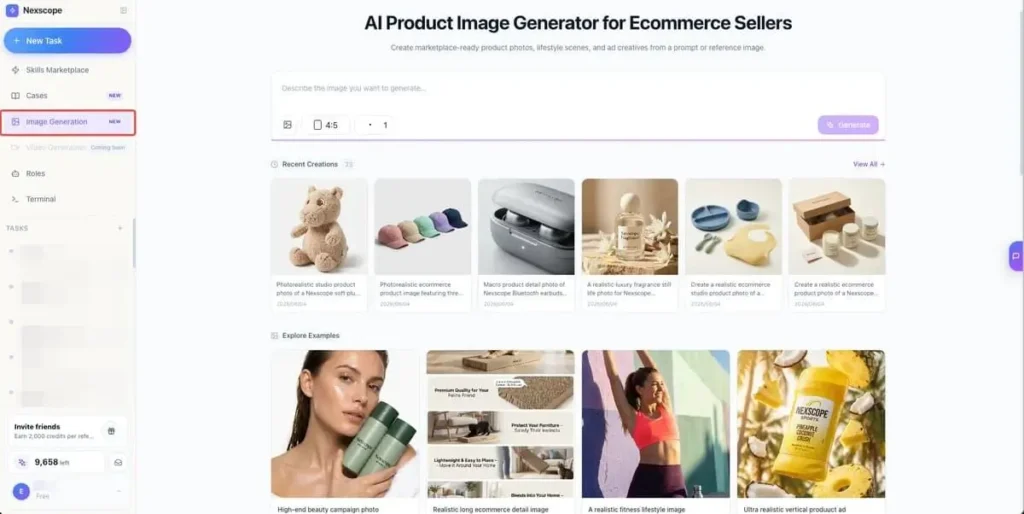
Now let’s move to the creative side.
This is where Nexscope could save time for smaller ecommerce businesses that don’t have an in-house designer or photographer.
The platform offers several image creation and editing features. These include:
- Product listing image sets.
- Lifestyle product photography.
- Amazon A+ content.
- AI fashion model images.
- Product colour variations.
- Background removal.
- Image upscaling.
- Image translation.
- Product image remixing.
Let’s take a simple example.
You sell a bottle of face serum. You have a basic product photograph, but you want something more attractive for your product listing.
You can use Nexscope to create different visual versions, such as a clean white-background product image, a lifestyle scene with fruit and skincare ingredients, or a promotional image with a more polished background.
You can also create fashion model shots and different product variations.
That’s useful.
Hiring a photographer for every product variation can get expensive, particularly when you’re testing several products at once.
But AI-generated product photography has limitations.
Sometimes the product shape changes. Labels may contain incorrect text. Colours can look slightly different, and small packaging details may disappear.
For an ecommerce business, these are not minor problems.
Customers expect the product they receive to match the pictures they see online. So always compare generated images with the actual product before publishing them.
AI Video Generator for Product Advertising

Creating product videos is another area where sellers spend time and money. You need a script, visuals, editing, music, captions, and sometimes a person to present the product.
Nexscope tries to simplify this process with several AI video tools. Here’s what you get:
Image to Video
Upload a product photograph and turn it into a short video. This can be useful for adding movement to otherwise static product images.
URL to Video
Use a product URL as the starting point for a video. This can help when you already have a product listing and want to create promotional content around it.
AI UGC Videos
Generate creator-style promotional videos featuring AI presenters. This is useful for businesses that want social-media-style advertisements without arranging a new creator shoot for every product.
Video Clone
Use a reference video to recreate its general structure for another product. This can help when you have found an advertising format you want to adapt.
Bulk Video Creation
Create multiple video variations instead of producing each one separately.
Nexscope also supports different AI image and video models. Its official website lists models such as Nano Banana, Seedance, MiniMax, and GPT Image.
The exact model selection can change as the platform updates its available tools.
Is AI UGC good enough for advertising?
It can be useful, but don’t expect every generated video to look like a genuine customer testimonial.
AI presenters can sometimes have unnatural expressions, strange hand movements, or awkward product interactions.
And that’s a problem if your entire advertising strategy depends on looking authentic.
My suggestion is to generate several variations, watch them carefully, and use only the ones that look convincing.
Also, never present an AI-generated endorsement as a real customer’s personal experience.
Connect Nexscope With ChatGPT or Claude
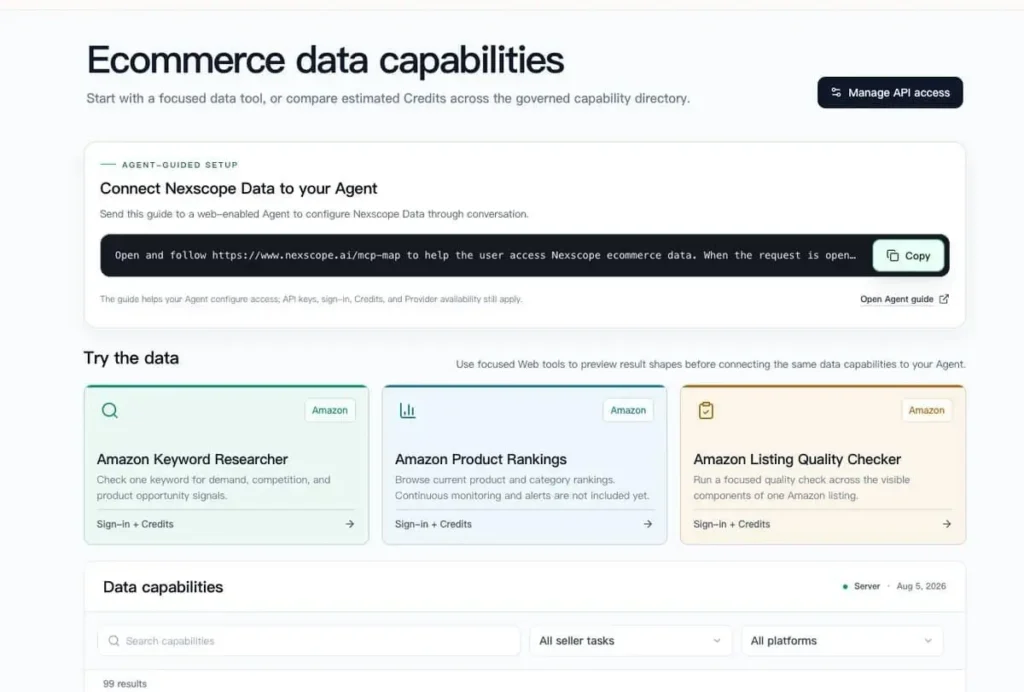
This is one of the more interesting features, especially for developers and people who regularly use AI assistants.
Nexscope provides API and MCP support that allows compatible AI assistants to access its ecommerce data and creative tools.
For example, you could connect an assistant such as Claude or ChatGPT and use it to work with marketplace research, keyword information, image generation, or video creation.
Imagine asking an AI assistant to research a product category, identify competitor keywords, and prepare a video concept for a selected product.
Instead of manually moving between different applications, the assistant can work with supported Nexscope capabilities through the connection.
This is useful for building repeatable workflows.
Agencies can also use APIs to build internal ecommerce research systems, while developers can integrate Nexscope capabilities into their own applications.
However, there’s a difference between connecting an AI assistant and having a fully autonomous ecommerce business.
You still need to provide instructions, review the results, check product information, and approve important decisions.
If you’re not interested in APIs, MCP, or AI agents, this feature might not matter much to you.
How Much Does Nexscope Cost?
Nexscope offers a free trial and three main paid plans: Starter, Growth, and Pro. Enterprise pricing is available separately.
Its pricing deserves some attention because the platform uses shared credits for research, image generation, video generation, and supported API operations.
Here are the monthly prices displayed on its official website.
| Plan | Monthly price | Monthly credits |
|---|---|---|
| Free Trial | $0 | 1,000 credits |
| Starter | $19 | 24,000 credits |
| Growth | $49 | 65,000 credits |
| Pro | $99 | 140,000 credits |
| Enterprise | Custom | Custom |
Prices in USD. Paid monthly prices and credit allocations checked against the official pricing page. Enterprise pricing requires contacting Nexscope.
What about the free trial?
The free trial provides 1,000 credits for three days, with no credit card required according to the official pricing page.
You can explore supported ecommerce data and creative features, although some restrictions apply. For example, free-trial video creation and cloning are available inside the Nexscope app, not through the video API.
Understanding the credit system
This is probably the most important thing to understand before subscribing.
Nexscope doesn’t give you unlimited research or unlimited video generation.
Every operation consumes credits, and the amount depends on the tool, model, settings, and type of request.
For example, the official pricing page estimates the following video capacity for selected models:
| Video model | Approx. cost per 5-second video | Starter | Growth | Pro |
|---|---|---|---|---|
| Seedance 2.0 Fast 720p | 550 credits | 43 | 118 | 254 |
| Seedance 2.5 1080p | 2,500 credits | 9 | 26 | 56 |
| Wan 3.0 1080p | 900 credits | 26 | 72 | 155 |
These are estimated maximum generation counts based on the listed model costs, not guaranteed output quantities for every workflow.
There are a few catches:
- Unused monthly subscription credits do not roll over.
- Data-only top-up credits cannot be used for image or video generation.
- Annual subscriptions are charged upfront, even though credits are allocated monthly.
- Higher-resolution and more expensive models can consume credits much faster.
So don’t select a plan simply because it offers a large credit balance.
First, estimate how many product searches, image generations, and videos you actually need every month.
What I Like About Nexscope
After looking at its features and pricing, there are several things that make the platform worth considering.
Practical advantages:
- Research and creative tools together: You don’t need separate platforms for every part of product research and content creation.
- Wide marketplace coverage: Support for Amazon, TikTok Shop, Shopee, Walmart, Etsy, eBay, and other marketplaces is useful for international sellers.
- Multiple AI creative tools: Product images, lifestyle scenes, UGC videos, and video cloning cover several common ecommerce content needs.
- API and MCP support: Developers and AI automation enthusiasts can build workflows around Nexscope.
- Manual approval for repricing: You retain control over suggested price changes.
- Free trial: You can explore the platform before committing to a paid subscription.
The biggest advantage is convenience. If you regularly research products and create advertising content, combining those activities could reduce the number of tools you need.
What I Don’t Like About Nexscope
Now for the less exciting part.
Nexscope has a lot of features, but there are a few things I’d think about before purchasing.
Practical disadvantages:
- Credit consumption: Research and creative work share the same monthly credit balance. Heavy video generation can eat through credits quickly.
- No unlimited generation: You need to monitor usage, especially when testing multiple AI models.
- AI content needs checking: Generated product images and videos can contain incorrect product details.
- Learning curve: Beginners may need time to understand the research tools, APIs, MCP connections, and credit system.
- Not every seller needs everything: A small store selling one or two products might never use most of the available features.
- No guaranteed marketplace success: Product research and repricing tools cannot guarantee sales, rankings, or Buy Box wins.
One more thing: Nexscope brings together a large number of data services, but that doesn’t automatically mean every data point is equally useful for every marketplace or country.
I’d test the exact marketplace and data type you plan to use before making it part of your daily business process.
Who Should Use Nexscope?
Nexscope isn’t for everyone. And that’s perfectly fine.
I’d recommend it to these groups:
Amazon and TikTok Shop sellers
If you regularly research products, monitor competitors, and create advertising content, Nexscope could be a useful addition to your workflow.
Multi-marketplace ecommerce businesses
Sellers working across Amazon, Shopify, Walmart, Shopee, and other platforms can benefit from having access to several marketplace data sources.
Ecommerce agencies
Agencies managing multiple stores or product campaigns may find the bulk creative tools and API integrations useful.
Product researchers and dropshippers
If you’re constantly searching for new products and comparing competitors, the marketplace research features are worth exploring.
Developers and AI automation builders
API and MCP support make Nexscope more interesting for people who want to connect ecommerce operations with AI assistants.
Who Should Avoid Nexscope?
I’d skip it if you’re in any of these situations.
- You have only one product and already have a photographer or designer.
- You rarely conduct product research.
- You need unlimited AI image and video generation.
- You only want a basic AI video generator.
- You don’t want to learn another platform with multiple tools and credit limits.
- Your ecommerce business isn’t generating enough revenue to justify another recurring expense.
Honestly, a beginner with a very small budget should focus on validating a product and getting the first few sales before paying for a large collection of research and creative tools.
You don’t need an expensive research setup to test every business idea.
Is Nexscope Worth It? My Final Verdict
Worth considering for active ecommerce sellers
Nexscope is an interesting combination of ecommerce research and AI content creation.
Its biggest selling point isn’t one particular feature. It’s the combination of marketplace data, keyword research, pricing tools, product photography, video generation, and AI agent connections.
For someone running an Amazon or TikTok Shop business, that combination can make daily work easier.
But I wouldn’t recommend buying the Pro plan just because it offers more credits.
Start with the free trial. Test the marketplace data you actually need. Generate a few product images and videos. Check how quickly the credits disappear.
Then decide whether the time saved justifies the subscription.
One important limitation of this review: no hands-on performance measurements or personal generation test results were supplied, so I’m not going to invent video quality scores, research accuracy figures, or time-saving claims.
My recommendation: Nexscope deserves a look from serious ecommerce sellers, multi-store operators, and agencies. But casual sellers and beginners should probably save their money until they have a real need for its research and creative features.
The tool can help with the work. It won’t run your business for you.
Alternatives to Nexscope
If you don’t think Nexscope is the right fit, here are five alternatives worth checking out. They cover some overlapping ecommerce creative, marketing, and research needs, although none should be assumed to offer the exact same combination of features.
1. ShopOS
ShopOS offers AI coworkers for ecommerce brands, covering product creative, catalogue management, advertising, SEO, and Shopify operations. It’s worth exploring if you want AI assistance with broader ecommerce tasks rather than only product research.
2. CreatOK
CreatOK creates TikTok Shop promotional videos using product images and reference videos. It’s a more focused option for sellers who mainly need short-form product advertising content.
3. Vmake Labs
Vmake turns product images and ideas into AI social videos with avatar presenters, captions, and translation. It may suit creators and sellers who need promotional videos for different social platforms.
4. Holo
Holo creates branded advertisements, social posts, and influencer-style videos using information from a business website. It’s worth considering if you want to produce different marketing assets without creating everything manually.
5. Hubfluence
Hubfluence helps businesses discover TikTok Shop creators and manage outreach for influencer and affiliate campaigns. It’s more suitable for brands that want to work with creators rather than generate all their promotional content using AI.