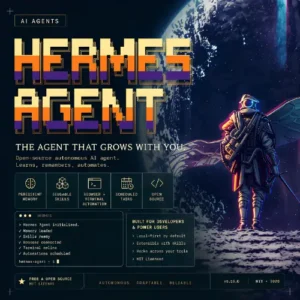
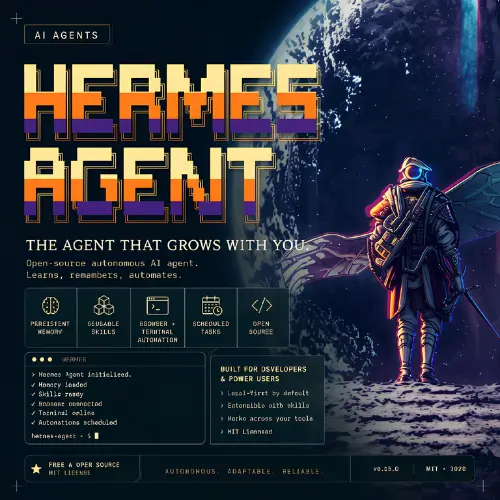
Most AI tools these days are pretty straightforward. You ask a question, you get an answer, and that’s it. Next time you talk to it, it has no memory of what happened before. It’s like meeting a stranger every single time. Hermes Agent from Nous Research is trying to change that in a way that feels almost like science fiction, but it’s actually happening right now.
I came across this tool recently and spent some time digging into what it actually does. The short version? It’s an open-source AI agent that you run on your own server. It lives in the background, takes tasks from places like Telegram or Slack, and gets better at its job the longer you use it. That last part is what makes it different from almost everything else out there.
What Makes Hermes Agent Different?
The core idea here is what the team calls a “learning loop.” After Hermes Agent finishes a complex task that involved five or more tool calls, it doesn’t just stop and wait for the next command. Instead, it takes a moment to think about what it just did. It reviews the steps it took, figures out what worked well, and writes a Markdown file to disk that captures those reusable patterns . This file is called a skill.
Here’s the part that genuinely surprised me. The next time a similar task comes in, Hermes doesn’t start from zero. It loads that skill file and follows the pattern it already figured out. Users have reported that research tasks they do repeatedly get completed about 40% faster after the agent has done them a few times. That’s not a small improvement. That’s the difference between an agent that’s a tool and one that’s almost like a junior colleague who’s actually paying attention.
And because everything is stored as plain Markdown files on your own filesystem, you can open them up and read them. You can see exactly what the agent has learned. If it picked up a bad habit, you can edit it out. If you want to teach it something specific, you can write a skill file yourself and drop it in. The team shipped version 0.10.0 with 118 bundled skills already included, so it doesn’t start completely empty .
How You Actually Use It
Hermes Agent isn’t something you open in a browser tab and click around. It’s designed to run on a server and wait for instructions. You can reach it through more than twenty messaging platforms. Telegram, Discord, Slack, WhatsApp, Signal, email, and even a command-line interface all work . The idea is that you send it a task from wherever you already are, and it handles things in the background without you needing to watch.
Deployment is flexible too. You can run it locally on your own machine, use Docker if you prefer containers, connect through SSH to a remote server, or use specialized backends like Modal and Singularity. The Docker setup comes with some solid security features built in, like read-only root filesystems and the ability to roll back changes if something goes wrong.
For the AI model itself, you’re not locked into anything. Hermes Agent works with OpenRouter, OpenAI, Anthropic, local models through Ollama or vLLM, and pretty much anything that speaks the OpenAI API format. You bring your own keys and pick the model that fits your budget and needs.
What the Hype Looks Like
The growth of this project has been genuinely wild. Hermes launched in February 2026 and hit 105,000 GitHub stars in just seven weeks . By May 2026, it had overtaken OpenClaw to become the most-used open-source agent on OpenRouter, processing 224 billion tokens in a single day. Those numbers are hard to wrap your head around, but they tell you something important: developers are paying attention.
The v0.13.0 release, nicknamed “Tenacity,” added a Kanban-style task board for managing multi-agent workflows. It includes features like heartbeat monitoring, zombie process detection, and hallucination recovery for long-running tasks. These are the kinds of things you only build when real people are using your tool for serious work and running into real problems.
The Stuff Nobody Tells You
I’d be doing you a disservice if I only talked about the good parts. There are some real caveats here that you should know about before you spend a weekend setting this up.
First, the skill files that Hermes writes are not reviewed or signed by anyone. They’re just files on disk. If someone manages to pull off a prompt injection attack, they could quietly write a bad skill file that causes problems later. The team has added features like per-skill locks against autonomous writes in recent releases, but the fundamental risk is still there .
Second, the skill search uses SQLite FTS5, which is keyword-based. If you ask Hermes to do something using different terminology than what it used before, it might miss a relevant skill entirely. This is a known limitation, and it means the learning loop isn’t as smart as it could be yet.
Third, token costs add up. The memory operations and meta-cognition that make Hermes Agent special aren’t free. On frontier models, these extra calls can get expensive quickly, especially if you’re running scheduled tasks or long-running workflows. You need to watch your provider spending limits closely .
And finally, this is not a SaaS product. You need a server, some comfort with Docker or SSH, and a willingness to read documentation. If you’ve never set up a VPS before, there’s going to be a learning curve.
Pricing Breakdown
The software itself is free and open source under the MIT license. You pay for two things: the server it runs on and the AI model it uses.
| Cost Component | What You Pay | Notes |
|---|---|---|
| Hermes Agent Software | $0 | MIT license, fully free |
| VPS / Server | ~$5–$20/month | Depends on provider and specs; 4GB RAM minimum recommended |
| AI Model (budget) | ~$0.12–$0.30 per 1M input tokens | Models like Hermes 3 70B on Hyperbolic or DeepInfra |
| AI Model (frontier) | Varies widely | GPT-5.6, Claude Sonnet 5, etc. cost significantly more |
| Nous Portal Plus (optional) | $20/month | Includes $22 in credits, access to 200+ models |
| Nous Portal Super (optional) | $100/month | Includes $110 in credits |
| Nous Portal Ultra (optional) | $200/month | Includes $220 in credits |
| Managed Hosting (Railway) | ~$5–$10/month | Container only; model costs separate |
A realistic budget for a light personal setup is somewhere around $10–$25 per month total, assuming you use a budget model for most tasks and only switch to something expensive when you really need it. Heavy users running multiple scheduled tasks and subagents should expect significantly higher token bills.
My Honest Take
Hermes Agent is not for everyone. If you just want a chatbot that answers questions, stick with ChatGPT or Claude. If you want something that schedules tasks and sends messages to your phone, there are simpler tools out there.
But if you’re a developer or a technical team that runs recurring workflows and you’re tired of explaining the same context over and over again, this is genuinely interesting. The idea that an agent could get measurably better at your specific tasks over weeks and months is compelling. The fact that you can inspect and edit what it learns makes it feel less like a black box and more like a tool you actually control.
The project is still young, and some rough edges are obvious. The search limitation is annoying. The token costs can surprise you. And the setup requires real effort. But the core idea—an agent that compounds in value the longer you use it—is the right direction for this technology. Hermes is the most technically interesting open-source agent available right now, and it’s worth trying if you have the patience to set it up properly.
Alternatives to Hermes Agent
CREAO
Turns successful AI work sessions into reusable agents with memory, schedules, and connectors. It’s closer to a no-code automation platform than a raw agent framework, aimed at teams who want to capture and replay successful workflows.
goose
An open-source desktop and terminal agent built by Block. It supports MCP extensions, local inference, reusable workflows, and subagents, with a strong focus on developer workflows and model flexibility.
OpenClaw
A Node.js-based self-hosted agent with the widest messaging channel support in the category. It focuses on personal-assistant reach rather than self-improving skills, making it a better fit for people who prioritize connection options over learning loops.
n8n
A self-hosted automation platform with visual workflow building, AI agent nodes, and human-in-the-loop approvals. It’s not a dedicated agent like Hermes, but it’s excellent for connecting AI agents to business systems and APIs.
Dify
A visual platform for building agents, RAG pipelines, and chat applications. It publishes workflows as apps, APIs, or MCP tools, making it a good choice for teams that want to build and ship AI-powered products without managing server infrastructure directly.