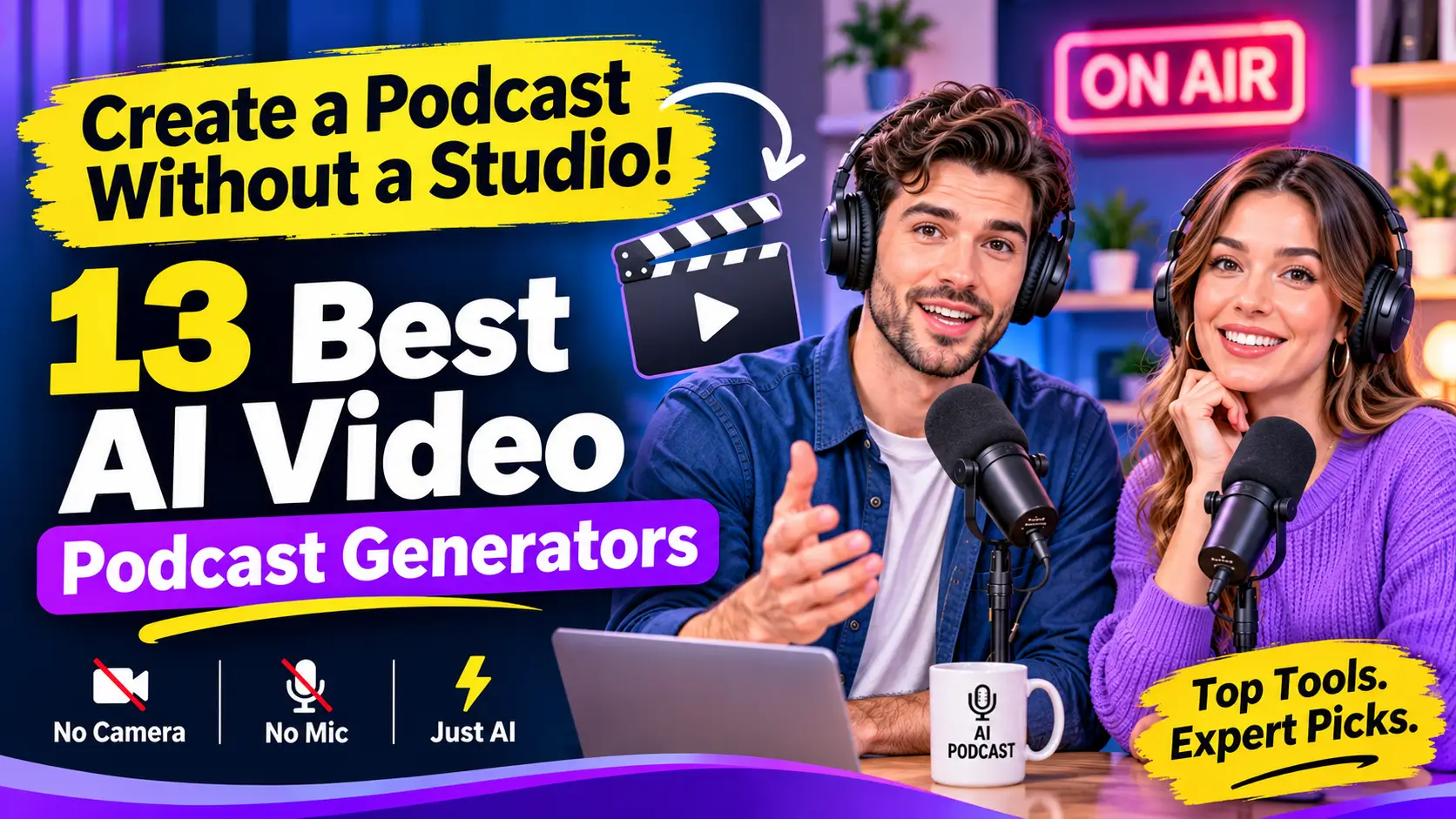
Creating a video podcast used to require cameras, microphones, studio equipment, multiple people and hours of editing. But today, AI tools can handle much of this work for you. You can provide a topic, upload a script or use an existing audio recording to create a podcast-style video with AI-generated hosts.
However, not every AI podcast generator creates an actual video podcast. Some tools only generate two AI voices and display a waveform, while others create realistic AI presenters, lip-synced conversations, studio backgrounds and camera transitions.
This guide focuses on software that can produce a visual podcast experience. Some tools are designed for complete AI-generated episodes, while others are better for converting existing audio into videos or creating short podcast clips.
We have included 13 AI video podcast tools, compared their features, explained their limitations and highlighted the type of creator who may benefit from each one.
Quick Comparison: Best AI Video Podcast Software
| Software | Best For | Main Input | Video Format |
|---|---|---|---|
| OpenArt | Cinematic AI podcast videos | Topic or script | Studio-style video |
| VisionStory | Converting audio into video podcasts | Audio, script, URL or PDF | Two-host video |
| AI Studios | Business and multilingual podcasts | Text, script, article or notes | Presenter and interview videos |
| JoggAI | Flexible podcast creation | URL, PDF, audio or script | Two-host studio video |
| MagicLight | Animated and educational podcasts | Idea or script | Animated video |
| Revid | Podcast-style social media clips | Script or URL | Short vertical video |
| HeyGen | AI avatar conversations | Topic, URL, PDF or script | Two-host video |
| Fliki | AI-generated studio conversations | Topic or script | AI-hosted podcast video |
| Shorz | Custom two-host podcast videos | Dialogue script | Interview and talk-show video |
| StoryShort | Faceless podcast Shorts | Topic or dialogue | Vertical and landscape video |
| Digital Maker AI | Animated long-form podcasts | Topic or script | Animated studio video |
| VdoBloom | Podcasts from articles and PDFs | Topic, URL or PDF | Audiogram and talking avatars |
| Rewatch | Realistic two-host podcast clips | Topic or dialogue | Short-form video |
Features, durations and plan limits can change. Always check the official website before purchasing a subscription.
How We Selected These AI Video Podcast Tools
We considered the following features when selecting the software for this list:
- Video generation: The tool should produce an actual video, not just an audio podcast.
- AI hosts: It should support one or more visible AI presenters or characters.
- Voice generation: Each speaker should have a suitable voice.
- Lip synchronization: The host’s mouth movements should match the spoken dialogue.
- Podcast layout: The output should look like a podcast, interview, discussion or talk show.
- Export options: Users should be able to download or publish their videos on platforms such as YouTube, Instagram and TikTok.
We also considered input flexibility, video duration, editing features, language support and pricing transparency.
Not every product has the same level of independent user feedback. Some have established review histories, while others are newer tools with fewer publicly available user experiences. We have considered this when discussing their strengths and limitations.
1. OpenArt – Best for Cinematic AI Video Podcasts
OpenArt is an AI content creation platform that offers tools for generating images, videos, characters and other visual content. Its AI podcast generator is particularly interesting for creators who want more control over the visual presentation of their podcast.
One of its main advantages is the Director workflow. Instead of relying entirely on a fixed podcast template, users can work with reusable AI hosts, virtual environments and different camera shots.
You can create a podcast scene, select your characters and use written instructions to make changes to the presentation. This makes it useful for creators who want their episodes to have a consistent visual identity.
Key Features:
- AI-generated podcast hosts and characters.
- Virtual podcast studios and backgrounds.
- Multiple camera shots and visual directions.
- Reusable characters and environments.
- AI voice and video generation.
- Creative control over podcast scenes.
Why Choose OpenArt?
OpenArt is a good option when visual presentation is an important part of your content strategy. You can experiment with different podcast environments and create a recognisable style for your channel.
For example, an AI technology podcast could feature two hosts discussing new software inside a modern virtual studio.
Limitations: The advanced video-generation workflow may consume credits quickly. Also, impressive short demonstrations do not necessarily guarantee consistent long-form podcast production. Test a short episode before investing in a larger project.
Best For: YouTube creators, AI content producers and people who want cinematic podcast scenes with reusable characters.
2. VisionStory – Best for Converting Audio Podcasts into Videos
VisionStory is useful for people who already have podcast recordings but want to turn them into visual content.
Instead of recording a new video podcast, you can upload an existing audio file and let AI create a visual presentation around the conversation.
The platform supports different types of input, including audio recordings, topics, scripts, URLs and PDF documents.
One interesting feature is its two-person podcast workflow. It can assign dialogue to two speakers and create a studio-style video with close-ups, medium shots and shared frames.
This makes the final video look more like an interview instead of a static image with an audio waveform.
Key Features:
- Audio-to-video podcast generation.
- Two-person podcast layouts.
- AI-generated characters and presenters.
- Multiple camera compositions.
- Custom backgrounds.
- 16:9 and 9:16 video formats.
Why Choose VisionStory?
Its biggest advantage is the ability to use existing audio recordings. If you already publish audio podcasts, you can reuse your content instead of starting from scratch.
It can also help creators produce video versions of interviews and discussions without setting up cameras.
Limitations: The documented podcast workflow has a ten-minute limit. Speaker assignment and overlapping conversations can also create problems. You should test recordings with interruptions before processing a complete episode.
Best For: Existing podcasters who want to convert short audio conversations into video podcasts.
3. AI Studios – Best for Business and Multilingual Podcasts
AI Studios by DeepBrain AI is an AI video creation platform designed for business videos, presentations, training content and digital presenters.
It also offers AI podcast video generation, allowing users to turn topics, articles, scripts and notes into podcast-style videos.
The platform provides a large collection of AI avatars and voices. It also supports multiple languages, which can be helpful for businesses creating content for international audiences.
For example, a company could prepare a product discussion in English and then create versions for different language markets.
Key Features:
- AI avatar presenters.
- Podcast and interview video layouts.
- Multiple AI voices.
- Multilingual video creation.
- AI-generated scripts and presentations.
- Captions and translation features.
- Business video production tools.
Why Choose AI Studios?
AI Studios is a practical choice for companies, educators and marketing teams that need repeatable video production.
It is particularly useful when you want a consistent presenter style across multiple videos or need to create localized content.
Its wider platform also makes it useful beyond podcast production.
Limitations: AI presenters may sometimes look unnatural, and lip synchronization may require additional work. Some advanced features and longer video limits depend on the subscription plan.
Best For: Businesses, corporate training teams, educators and multilingual content creators.
4. JoggAI – Best for Flexible Podcast Inputs
JoggAI is an AI video creation platform that offers different ways to turn existing content into videos.
Its podcast creation workflow supports multiple input types, including URLs, YouTube videos, PDFs, text, scripts and audio recordings.
This flexibility makes it useful for creators who work with different types of source material.
For example, you can take an article from your website and turn it into a conversation between two AI hosts. You can also use an existing audio recording to create a podcast-style visual presentation.
Key Features:
- AI podcast video generator.
- Two-speaker podcast layouts.
- Text-to-video creation.
- URL and PDF inputs.
- Audio-to-video workflow.
- AI avatars and voices.
- Subtitle customization.
- Landscape and vertical formats.
Why Choose JoggAI?
Its multiple input options make it convenient for content creators who want to repurpose existing material.
You can use the same platform for different content ideas instead of relying on separate tools for every format.
Limitations: The dedicated podcast workflow has fewer editing controls than a professional video editor. Advanced editing, inline images and playback-speed adjustments may require another application.
Best For: Bloggers, YouTubers and marketers who want to convert different types of content into podcast videos.
5. MagicLight – Best for Animated and Educational Podcasts
MagicLight takes a different approach to AI video podcast production.
Instead of focusing only on realistic human presenters, it supports animated characters, cartoon hosts and other visual styles.
This makes it interesting for educational channels, children’s content, storytelling and entertainment.
You can provide an idea or script and use AI-generated characters, backgrounds, voices and subtitles to create a complete video.
The platform also supports longer projects, with documented project durations of up to 50 minutes.
Key Features:
- AI-generated animated characters.
- Human and cartoon-style presenters.
- AI voice generation.
- Voice cloning features.
- Automatic subtitles.
- Custom scenes and backgrounds.
- 16:9 and 9:16 video formats.
- Long-form video creation.
Why Choose MagicLight?
It is a suitable choice for creators who do not want their podcast to look like a traditional studio interview.
For example, an educational YouTube channel could create an animated discussion between a teacher and a student.
Limitations: Character consistency and voice assignments should be checked carefully. Longer projects can consume substantial credits, especially when scenes need to be regenerated.
Best For: Educational YouTube channels, animated podcasts, children’s content and storytelling creators.
6. Revid – Best for Podcast-Style Shorts and Reels
Revid is an AI video creation platform focused on helping creators produce short-form social media content.
Its AI podcast generator can turn a script or URL into a conversation between AI characters.
You can assign dialogue to different speakers and generate a video featuring animated, lip-synced avatars, captions and supporting visuals.
Unlike traditional podcast production tools, Revid focuses more on short videos that can be published on TikTok, Instagram Reels and YouTube Shorts.
Key Features:
- AI podcast video generation.
- Multiple AI speakers.
- Animated avatars.
- Automatic captions.
- Script-to-video creation.
- Short-form video production.
- Social media content tools.
- API and automation options.
Why Choose Revid?
Revid is useful when you want to create several short podcast-style videos around different topics.
For example, a creator can turn a discussion about artificial intelligence into multiple short videos covering individual questions.
Limitations: The output can look generic without additional editing. Some users have also reported concerns about credits, generation quality and customer support. Check the export rules and pricing before subscribing.
Best For: Social media marketers, faceless YouTube creators and people producing short podcast clips.
7. HeyGen – Best for AI Avatar Conversations
HeyGen is a popular AI avatar video creation platform used for marketing, presentations, training and social media content.
Its AI Video Podcast feature allows users to create a conversation between two AI presenters.
You can provide a topic, prompt, URL, document or your own script. The platform generates dialogue and creates a video featuring two AI hosts.
The output can include different camera shots, captions, voices and supporting visuals.
Key Features:
- AI-generated presenters.
- Two-host podcast videos.
- Custom AI avatars.
- AI voice generation.
- Multiple languages.
- Automatic captions.
- Script-based video generation.
- Video translation and localization.
Why Choose HeyGen?
HeyGen is worth considering if you already use AI avatars for your business or social media content.
Its wider avatar and translation capabilities can also help companies produce different versions of the same content.
Limitations: Be careful when comparing the general HeyGen video duration with the dedicated Video Podcast feature. Its help documentation updated in July 2026 describes the podcast feature as supporting two speakers and episodes of up to three minutes. Longer content may need to be created in multiple sections and combined separately.
Credit usage, avatar availability and generation queues can also affect production costs.
Best For: Businesses, marketers and creators who want polished AI presenter videos and short two-host discussions.
8. Fliki – Best for AI-Generated Studio Conversations
Fliki is an AI video creation platform that has expanded beyond basic text-to-video production.
Its video podcast maker can turn a topic or written script into a studio-style podcast featuring two AI-generated hosts.
The platform creates the conversation, assigns voices and generates talking-head presenters. It also uses an AI-directed camera workflow to switch between wide shots and individual host close-ups.
Users can customize their hosts, voices and studio backgrounds.
Key Features:
- AI-generated two-host conversations.
- Custom AI presenters.
- AI voice generation.
- Podcast studio backgrounds.
- Automatic camera transitions.
- Script-based podcast creation.
- Landscape, portrait and square formats.
Why Choose Fliki?
Fliki is interesting for creators who want a complete podcast video without recording themselves.
Its combination of AI scripting, voice generation and visual production can reduce the time needed to prepare short podcast episodes.
It can also fit into a wider content workflow because Fliki offers other video creation and editing features.
Limitations: The dedicated video podcast maker documents episodes of up to ten minutes. Check the available subscription and generation allowance before planning longer episodes.
Best For: YouTube creators, marketers, educators and people who want AI-generated studio conversations.
9. Shorz – Best for Custom Two-Host Podcast Videos
Shorz offers a dedicated AI podcast generation workflow for creating two-person conversations.
You can write a dialogue, assign a voice to each speaker and select two AI avatars. The platform then generates a podcast-style video using the dialogue.
It supports different presentation styles, including side-by-side layouts and shots focused on the person currently speaking.
Shorz also offers additional video tools such as automatic subtitles, AI B-roll, video generation and editing features.
Key Features:
- Two-host podcast generation.
- Custom AI avatars.
- Separate voices for each speaker.
- Dialogue-based video creation.
- Split-screen and speaker-focused layouts.
- Automatic captions.
- AI-generated B-roll.
- Additional video editing tools.
Why Choose Shorz?
Shorz is a useful option for creators who want more than a simple talking-avatar video.
Its two-speaker workflow can be used for interviews, debates, educational discussions, product conversations and short news shows.
It may also be useful for creators who want podcast production and other AI video tools in one platform.
Limitations: You should test the avatar movements, dialogue timing and overall visual quality before using it for a regular publishing schedule. Costs and generation allowances should also be checked before producing longer episodes.
Best For: Faceless YouTube channels, marketers and creators producing interview-style content.
10. StoryShort – Best for Faceless Podcast Shorts
StoryShort is an AI video creation platform designed for creators who want to publish short videos without appearing on camera.
Its AI podcast generator creates a conversation between two AI hosts using a topic or written dialogue.
You can assign different characters to each speaker and generate a video with AI voices, lip synchronization and animated captions.
The tool also supports different aspect ratios, including 9:16, 1:1 and 16:9.
Key Features:
- Two AI podcast hosts.
- AI-generated dialogue.
- Different voices for each speaker.
- Lip-synced AI avatars.
- Automatic animated captions.
- Full-screen and split-screen layouts.
- Multiple aspect ratios.
- Built-in video editor.
Why Choose StoryShort?
StoryShort is particularly interesting for creators who want to run a faceless social media channel.
For example, you can create short conversations about technology, business, education or entertainment without recording your own voice.
Its vertical video support also makes it suitable for YouTube Shorts, Instagram Reels and TikTok.
Limitations: It is more focused on short-form content than traditional long-form podcast production. The output should be reviewed for dialogue quality, avatar consistency and caption accuracy.
Best For: Faceless YouTubers, social media creators and short-form video marketers.
11. Digital Maker AI – Best for Animated Long-Form Podcasts
Digital Maker AI is another interesting platform for generating animated podcasts with two AI hosts.
You provide a topic, and the platform creates a conversation between two speakers. It then assigns different AI voices and places the characters inside an animated podcast studio.
One useful feature is the ability to save your show and studio settings. This helps creators maintain a similar appearance across multiple episodes.
The platform also supports longer podcast projects, depending on the subscription plan.
Key Features:
- Two AI-generated podcast hosts.
- Automatic conversation writing.
- Different AI voices.
- Animated studio environments.
- Reusable characters and show settings.
- Automatic captions.
- Downloadable MP4 videos.
- Support for longer episodes.
Why Choose Digital Maker AI?
This platform can be useful for educational channels and creators who prefer animated presenters over realistic AI avatars.
For example, an English-learning channel could create conversations between two animated characters to explain vocabulary, grammar and everyday communication.
Its reusable studio settings can also help establish a consistent channel identity.
Limitations: Podcast voices use the platform’s built-in voice options rather than custom cloned voices. The free version includes a watermarked podcast, while longer episodes require higher subscription tiers.
Best For: Educational creators, animated YouTube channels and faceless content producers.
12. VdoBloom – Best for Turning Articles and PDFs into Video Podcasts
VdoBloom offers an AI podcast generator that can convert written information into a two-host conversation.
You can provide an article URL, upload a PDF or enter a topic. The platform creates a conversation between two speakers, which you can edit before generating the final content.
One interesting feature is the choice between different video presentations.
You can create an audiogram-style video with captions and waveforms or use talking AI avatars that appear on camera.
Key Features:
- Article-to-podcast generation.
- PDF-to-podcast conversion.
- AI-generated two-host dialogue.
- Editable podcast scripts.
- Different AI voices.
- Talking AI avatars.
- Word-synchronized captions.
- Multiple language options.
Why Choose VdoBloom?
VdoBloom is worth considering if you regularly publish articles, tutorials or educational content.
Instead of writing a completely new podcast script, you can use an existing article as the starting point.
The option to edit the dialogue before generating the video is also useful for maintaining better control over the final content.
Limitations: Its documented podcast workflow focuses on shorter episodes of one, three or five minutes. Talking-avatar generation also has a separate cost structure, so check the price before generating a complete episode.
Best For: Bloggers, educators, publishers and content marketers who want to repurpose written material.
13. Rewatch – Best for Realistic Two-Host Podcast Clips
Rewatch offers an AI podcast video generator that creates a conversation between two realistic-looking AI presenters.
You can provide a topic or write your own dialogue. Each speaker gets a separate voice and AI-generated appearance.
The platform can also use uploaded host photos, allowing creators to build videos around selected presenters, provided they have the necessary rights to use those images.
It generates a podcast-style video with speaker-focused shots, split-screen layouts and captions.
Key Features:
- Two AI podcast hosts.
- Realistic AI presenters.
- Separate voices for each speaker.
- Custom host photos.
- Lip-synchronized dialogue.
- Full-screen and split-screen layouts.
- Automatic captions.
- Short-form video exports.
Why Choose Rewatch?
Rewatch is an interesting option for creators who want a realistic two-person discussion without filming two people.
It can be useful for interview clips, educational conversations, debates and short podcast teasers.
The ability to use your own host images is another useful feature for creators who want a consistent visual identity.
Limitations: Its current workflow is focused on captioned vertical videos and short-form publishing rather than full-length podcast production. Review the generation cost and available export options before using it for a regular series.
Best For: Short-form podcasters, educators and social media creators.
Other AI Tools Worth Watching
Some additional platforms offer AI video podcast features but need more testing before they can be recommended alongside the main tools.
Higgsfield
Higgsfield offers AI video generation with camera controls, visual effects and a dedicated podcast generator.
Its podcast workflow supports AI hosts, studio environments, camera movements and supporting visuals. It may be useful for creators who want more cinematic-looking podcast videos.
However, its podcast-specific duration limits and production costs should be checked before using it for regular long-form episodes.
AtoV.ai
AtoV.ai offers audio-driven video generation, including a two-person workflow.
You can upload an image containing two people and provide separate audio tracks for each speaker. The platform then animates the characters according to the supplied voices.
This makes it interesting for people who already have recorded podcast audio and want to create a visual version.
It is more of an audio-to-video animation workflow than a complete topic-to-podcast production platform.
AI Video Podcast Software vs Traditional Podcast Editing Tools
It is important to understand that AI video podcast generators and traditional podcast editing platforms solve different problems.
AI video podcast generators can create virtual hosts, voices and conversations without requiring a real recording session.
Traditional podcast tools are designed to help people record, edit and improve their actual recordings.
Here are a few popular tools that can complement an AI podcast workflow.
| Tool | Main Purpose | Best For |
|---|---|---|
| Riverside | Remote podcast recording | Real interviews and recordings |
| Descript | Audio and video editing | Editing recorded podcasts |
| OpusClip | AI-powered video clipping | Turning long videos into short clips |
| Podcastle | Podcast recording and editing | Audio and video podcast production |
| CapCut | Video editing | Captions, transitions and social media editing |
These platforms are useful for different stages of podcast production, but they should not automatically be considered complete AI-hosted podcast generators.
Final Verdict: Which AI Video Podcast Software Should You Choose?
The best AI video podcast software depends on the type of content you want to produce.
If you want cinematic scenes and reusable AI hosts, start with OpenArt. If you already have an audio recording, VisionStory is worth considering. For business content and multilingual production, AI Studios offers a wider range of features.
Fliki and Shorz are interesting alternatives for generating complete podcast-style conversations. StoryShort and Rewatch are more suitable for short-form social media videos, while Digital Maker AI is worth exploring for animated educational podcasts.
VdoBloom is another useful option if you want to turn existing articles and PDFs into conversations.
Before purchasing a subscription, create a short test video. Check the lip synchronization, voice quality, speaker assignment, character consistency, video resolution and actual credit consumption.
A good-looking demonstration is not enough. The real test is whether the software can produce consistent videos that your audience will enjoy watching.
You can also explore more AI Podcasting Tools and AI Video Generation Tools to discover additional software for your content creation workflow.
Frequently Asked Questions About AI Video Podcast Software
1. What is AI video podcast software?
AI video podcast software helps users create podcast-style videos using artificial intelligence. Depending on the platform, it can generate scripts, AI voices, virtual hosts, lip-synced conversations, backgrounds, captions and camera transitions.
2. Can I create a video podcast without showing my face?
Yes. Tools such as OpenArt, HeyGen, StoryShort, Fliki and Digital Maker AI allow you to create podcast-style videos using AI-generated characters or presenters.
You do not necessarily need a camera, microphone or co-host.
3. Which AI tool is best for creating two-host podcasts?
OpenArt, VisionStory, AI Studios, JoggAI, Fliki and Shorz are worth considering for two-host podcast creation.
The best option depends on whether you want realistic presenters, animated characters, an audio-to-video workflow or more control over camera direction.
4. Can I convert an audio podcast into a video using AI?
Yes. VisionStory is designed for converting existing audio into a podcast-style video. Other options include JoggAI and audio-driven tools such as AtoV.ai.
You can also use traditional video editing software to add subtitles, visuals and waveforms to your existing recording.
5. Which AI podcast generator is best for YouTube?
For longer educational and business videos, consider AI Studios and Digital Maker AI. OpenArt is worth exploring for visually directed podcast scenes.
For shorter YouTube videos and Shorts, StoryShort, Revid, Fliki and Rewatch are useful options.
6. Can AI podcast generators create videos in different languages?
Several platforms offer multilingual voices, translation or localized video creation.
AI Studios and HeyGen are particularly relevant for multilingual production. VdoBloom also documents support for languages including Hindi, Tamil, English, Spanish, Arabic, French and German.
Always test pronunciation and voice quality before publishing.
7. Are AI-generated podcast videos suitable for monetized YouTube channels?
AI-generated videos can be published on YouTube, but using AI does not automatically make a video eligible for monetization.
Creators should focus on original scripts, useful information, meaningful commentary and quality production. Repetitive, mass-produced or low-value content may face monetization problems.
You should also disclose realistic altered or synthetic content when required by YouTube’s policies.
8. Can I use AI-generated podcast videos commercially?
Commercial usage depends on the software’s terms, subscription plan, generated assets and the rights associated with any uploaded material.
Before publishing sponsored or commercial content, review the platform’s licensing rules. Also ensure you have permission to use uploaded photographs, voices and likenesses.
One Response
Amazing blog with detailed information!